

A pharmacy benefit manager (PBM) contract can affect prescription drug costs, employee access to medications, and how much financial information an employer receives. Employers should compare net costs, pricing definitions, rebates, fees, pharmacy access, reporting rights, audit provisions, and exit terms using consistent assumptions.
A large rebate guarantee or discount percentage alone does not establish the better arrangement. For self-funded employers and benefits brokers, the goal is to understand the full financial and operational terms before signing or renewing an agreement.
Key takeaways
- Compare net costs using consistent claims and contract definitions.
- Assess member access alongside financial guarantees.
- Put data access, audit rights, and termination terms in writing.
What should a pharmacy benefit manager contract explain?
A pharmacy benefit manager (PBM) administers aspects of prescription drug benefits for a health plan, including functions such as claims processing, pharmacy network management, and formulary administration.
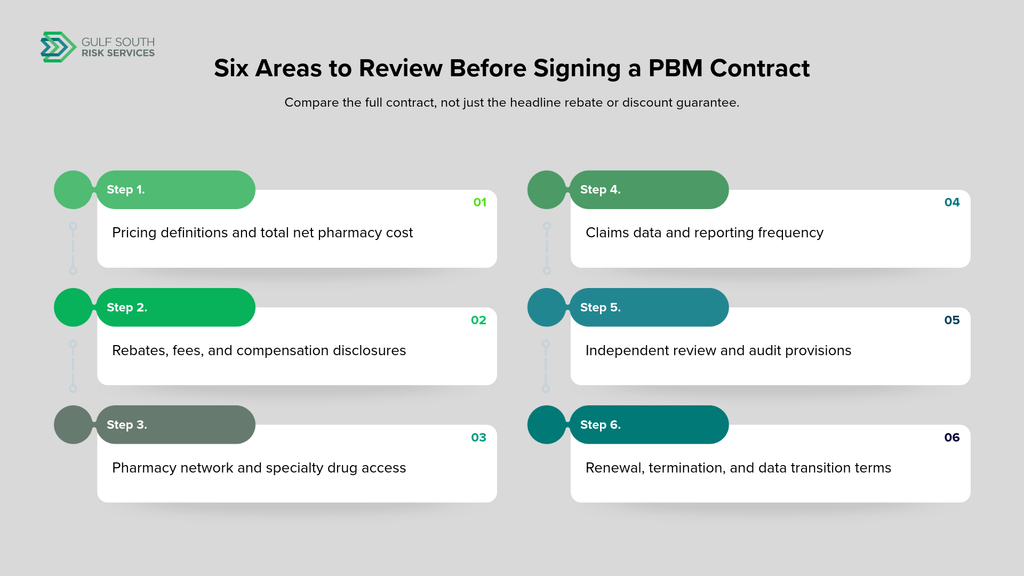
A pharmacy benefit manager contract should clearly describe the services provided, the parties responsible, the agreement term, and the conditions governing pricing and performance. Employers should check whether the contract covers retail prescriptions, mail-order services, specialty medications, or other arrangements, and identify any exclusions.
Ask how the agreement defines brand-name, generic, and specialty drugs. These classifications can affect pricing guarantees, rebates, and which claims count toward performance measures. The contract should also explain what happens when a drug changes category or is excluded from a guarantee.
Review the full contract and its schedules, not just the sales presentation. Terms such as “transparent pricing” do not have one universal contractual meaning. Ask for written definitions and clarification of any compensation, service, or reporting provisions that remain unclear.
Employers new to this process can review what a pharmacy benefit manager does before comparing specific proposals.
How do you compare pricing, rebates and total net cost?
Compare PBM pricing by calculating the plan’s total net pharmacy cost using the same claims, fees, rebate assumptions, and contract definitions for every proposal. A discount rate or rebate guarantee can look attractive without showing what the plan ultimately pays.
In a pass-through pricing arrangement, the PBM generally passes through specified manufacturer rebates or pharmacy payments according to the contract. Employers should confirm exactly which amounts are passed through and what fees remain. Under spread pricing, the PBM charges the plan more for a prescription than it reimburses the dispensing pharmacy, retaining the difference under the arrangement.
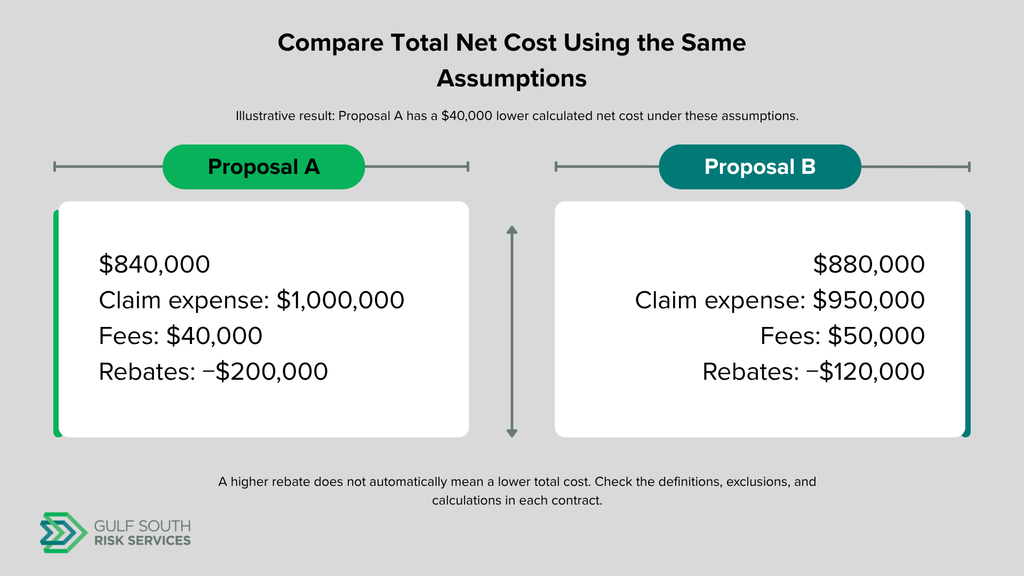
Consider this simplified hypothetical comparison using the same claims assumptions:
| Cost component | Proposal A | Proposal B |
| Plan claim expense | $1,000,000 | $950,000 |
| Fees | $40,000 | $50,000 |
| Credited rebates | -$200,000 | -$120,000 |
| Total net cost | $840,000 | $880,000 |
In this example, Proposal A has the lower net cost despite its higher claim expense. The calculation is illustrative, not a prediction. Actual analysis must account for contract definitions, exclusions, and whether amounts are already included in claim expense.
Effective rebate transparency means understanding what the contract credits, when payments are reconciled, and which compensation falls outside the guarantee. Employers can also review cost containment and plan optimization to consider pharmacy costs alongside the wider health plan. For plans covered by the Employee Retirement Income Security Act (ERISA), the U.S. Department of Labor advises fiduciaries to compare service providers on consistent information, understand fees, and monitor performance.
U.S. Department of Labor
Which member-access and specialty-drug terms matter?
A PBM contract should explain how its formulary, pharmacy network, specialty drug rules, and transition procedures affect members. A financially attractive proposal may still create operational challenges if employees lose access to a pharmacy or face unexpected changes to prescription coverage.
Ask each vendor:
- How are formulary changes communicated, and what happens when a covered medication is removed or moved to a different tier?
- Which retail and mail-order pharmacies are in network, and are there restrictions on where members can fill prescriptions?
- How does the contract define specialty medications, and which specialty pharmacy terms affect pricing guarantees or required dispensing channels?
- What transition support is available for members whose current pharmacy or medication arrangement changes?
Request clear explanations of mandatory pharmacy channels, exceptions, and member support processes. Do not assume every member can switch providers without disruption or that a particular pharmacy arrangement will produce savings.
Review the proposed terms against the needs of your workforce, including employees who rely on ongoing prescriptions. Changes should be communicated through the plan’s established process, with appropriate support for affected members.
What reporting and audit rights should you request?
A PBM contract should specify what data the employer receives, how often it is delivered, who can access it, and what review rights apply. Clear provisions help employers evaluate financial performance and verify whether the vendor is meeting its contractual commitments.
During a PBM contract review, ask for written answers to these questions:
- Claims data: Can authorized recipients access claim-level information, including drug identifiers, quantities, paid amounts, member cost sharing, and relevant pharmacy details?
- Reporting frequency: Are reports delivered monthly, quarterly, or on another agreed schedule?
- Rebates and fees: Can the employer reconcile credited rebates, administrative fees, exclusions, and other compensation covered by the agreement?
- Guarantee methodology: Are the calculations, measurement periods, exclusions, and remedies clearly defined?
- Independent review: Does the contract permit an independent reviewer to examine relevant records, and who pays for the review?
- Data handling: How are sensitive records transferred, protected, retained, and made available to authorized parties?
Specific pharmacy benefit audit rights should be written into the contract rather than assumed. Clarify the review period, notice requirements, record access, confidentiality obligations, and process for resolving disputed findings.
The Department of Labor’s January 2026 proposed PBM fee disclosure rule addresses compensation disclosures and auditing for certain self-insured employer health plans. It is a proposal, not a blanket statement of current legal requirements. Employers should check its status before relying on it and obtain qualified advice on applicable obligations.
U.S. Department of Labor+1
Which renewal, performance and exit terms need attention?
Renewal and exit terms determine how easily an employer can respond if the PBM’s performance or business needs change. Review these provisions before signing, not just when a renewal date approaches.
Check the contract for:
- Renewal notice: How far in advance must either party give notice to renew or end the agreement?
- Performance guarantees: What measures apply, which claims are excluded, and what remedies are available if guarantees are missed?
- Contract changes: Can pricing, formularies, pharmacy networks, or service terms change during the agreement?
- Termination costs: Are there early termination fees, minimum terms, or other financial conditions?
- Data transition: What data will be provided when the agreement ends, in what format, and on what schedule?
Before selecting a vendor, request the complete contract, pricing schedules, guarantee definitions, fee disclosures, sample reports, and relevant service descriptions. Ask for written answers to unresolved questions.
Gulf South Risk Services supports health plan technology and vendor integration, including PBM coordination and data integration. Its role can help connect the PBM with the wider administrative structure, but legal interpretation and contract negotiations should involve qualified advisers as appropriate.
Gulf South Risk Services
Frequently asked questions
Does a bigger rebate mean a lower-cost PBM contract?
No. Rebates are only one part of the calculation. Compare claim expenses, fees, credited rebates, exclusions, and other applicable terms to determine total net cost.
What is spread pricing?
Spread pricing occurs when a PBM charges a health plan more for a prescription than it pays the dispensing pharmacy, retaining the difference under the arrangement. Contract terms determine how pricing and compensation are handled.
Can an employer choose a different PBM?
Often, employers can evaluate alternative PBMs, but switching depends on contractual obligations, plan requirements, implementation arrangements, and potential transition costs. Review the existing agreement before making a change.
Make a more informed PBM contract decision
A thorough pharmacy benefit manager contract review considers financial terms, member access, reporting, audit provisions, and the practical requirements of changing vendors. Comparing proposals on consistent assumptions gives employers and brokers a clearer basis for evaluating the available options.
Gulf South Risk Services helps organizations coordinate health plan vendors and administration, including PBM integration. Employers and brokers can discuss how this coordination fits into their broader benefits arrangements and reporting needs.
Discuss PBM coordination with Gulf South Risk Services to explore the administrative support available for your health plan.