A useful TPA claims report helps employers understand health plan spending, enrollment-adjusted trends, major cost drivers, claim status, and administrative performance. Before comparing results, confirm the reporting period, metric definitions, and data completeness. The report should explain unusual changes and identify follow-up actions while protecting members’ health information.
For CFOs, HR leaders, benefits teams, and brokers, the goal is to understand what the data shows and what questions it raises.
- Confirm the period and denominator before comparing costs.
- Separate claim costs from administrative service performance.
- Review trends and explanations, not one headline number.
What should a TPA claims report include?
A report for a self-funded group health plan should provide enough context to understand spending and administration. Available details depend on the TPA agreement.
| Measure | What it shows | Question to ask |
| Total claims paid | Payments in the reporting period | Which dates are included? |
| Enrollment and member-months | Covered population over time | Did enrollment change? |
| Medical and pharmacy spending | Where plan dollars are going | Are categories reported consistently? |
| Major cost categories and large claims | Factors affecting spending | Is this a one-time change or a trend? |
| Claim status and service metrics | Processing and outstanding work | How are pending claims and turnaround defined? |
Reports may also include utilization, network use, and cost trends. Gulf South Risk Services describes reporting and analytics that help employers review utilization, cost drivers, and performance trends. For the underlying workflow, see health plan claims processing. Confirm which measures your administrator provides.
How do you compare claim costs fairly?
Compare equivalent periods and populations, and check whether the report shows paid claims or incurred claims. Paid claims reflect amounts paid during a period. Incurred claims relate to claims associated with a period, including eligible amounts that may not yet have been paid. Claims lag occurs because care, claim submission, and payment happen at different times.
Per member per month (PMPM) divides a selected cost by member-months. One member covered for one month equals one member-month.
Hypothetical example:
- $120,000 paid claims ÷ 300 member-months = $400 PMPM
- $132,000 paid claims ÷ 330 member-months = $400 PMPM
Total claims paid rose 10%, but PMPM stayed the same because enrollment increased. Per member per month claims comparisons help account for enrollment changes, but paid PMPM is not a complete estimate of ultimate incurred cost. Confirm how the report treats late claims, adjustments, and the reporting period.

Which changes deserve a closer look?
Review medical and pharmacy spending separately before combining them into an overall trend. Check whether changes reflect enrollment, timing, benefit design, utilization, pricing, or another factor supported by the data.
Large claims can have a substantial effect on totals. Ask whether a small number of high-cost claims account for much of the spending and whether the comparison uses consistent periods and populations. A large claim can reflect appropriate care. High spending alone does not prove waste or poor administration.
For plans with stop-loss coverage, check submission and reimbursement status separately from underlying claim activity. Stop-loss reporting can show whether a potentially eligible claim has been submitted or reimbursed. Recoveries should not be counted as lower underlying medical utilization.
What do service metrics say about administration?
Service metrics describe administrative performance, not the cost of care. Ask the TPA how each measure is defined, what it includes, and whether results cover all claims or a sample.
- Claims turnaround time: Does the measure cover clean claims only or all claims? A clean claim includes the information needed for processing.
- Pending claims and aging: How many claims await information or action, how long have they been pending, and why?
- Denial reasons and appeal outcomes: What patterns or explanations appear beyond the overall denial count?
- Payment accuracy: How is accuracy measured, and what sample or review method is used?
Faster processing or fewer denials alone does not prove better service. Metrics need definitions and context. Regulatory deadlines are not service averages, and one benchmark does not apply to every plan.
Connect reporting to the broader scope of health plan administration, including claims processing, eligibility, coordination, and member support. Ask which service measures are included in your agreement before using them to assess performance.
How should employers use a TPA claims report?
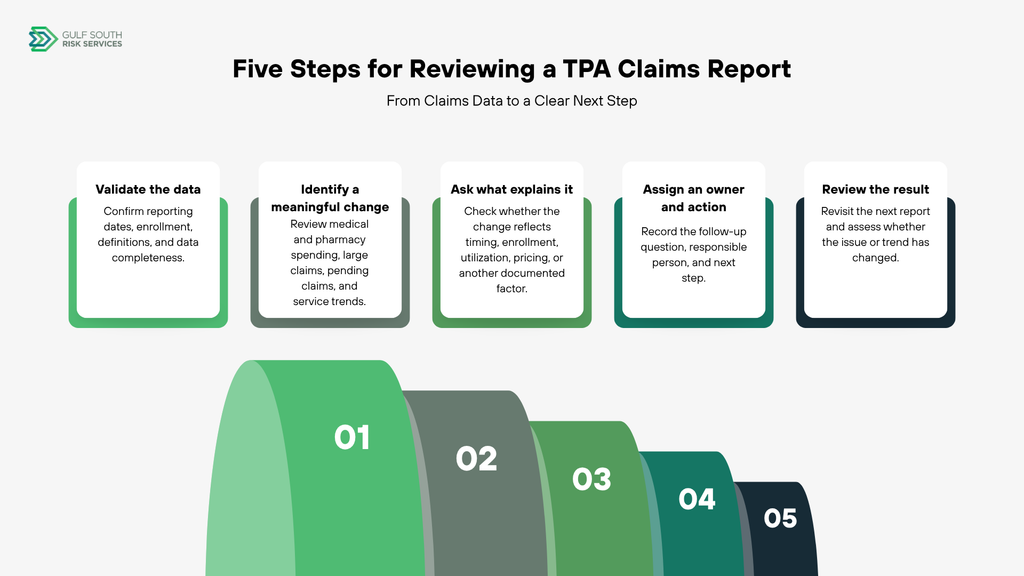
Use the report to guide a focused review meeting rather than simply archive monthly numbers.
Monthly review checklist
- Validate the data. Confirm the period, enrollment, definitions, and treatment of late claims or adjustments.
- Investigate one meaningful change. Ask what explains a cost, service, or claim-status movement.
- Assign an owner. Identify who will follow up with the TPA, pharmacy benefit manager, network, or stop-loss carrier.
- Agree on an action. Record the question, next step, and responsible party.
- Revisit the result. Check subsequent reporting to see whether the issue changed.
Eligibility data affects who is counted and whether claims align with coverage records. Stop-loss coordination and cost containment may also be relevant when reviewing a finding. Gulf South describes coordinating pharmacy benefit managers, provider networks, and stop-loss providers alongside reporting and analytics. Employers can explore possible next steps through cost containment and plan optimization.
Self-funded health plan reporting should give employers useful oversight without assuming unrestricted access to members’ identifiable medical information. Access depends on roles, plan arrangements, and applicable privacy requirements. The U.S. Department of Health and Human Services explains how the HIPAA Privacy Rule governs certain disclosures of protected health information by health plans and covered providers to employers.
Frequently asked questions
How often should employers review claims reports?
Agree on a schedule with the TPA based on the plan’s needs. Monthly reviews may help teams track changes, while quarterly or renewal meetings can support broader planning. Confirm which reports are available and when they are delivered.
What is PMPM?
Per member per month (PMPM) is a selected cost divided by member-months. It helps account for enrollment changes, but comparisons still require consistent periods, definitions, and claims data.
Can an employer see individual employees’ medical records?
Not automatically. Access depends on the employer’s role, plan arrangements, applicable privacy requirements, and the information requested. Employers should confirm what data they may receive and use rather than treating aggregate reporting as permission to access identifiable medical records.
Conclusion
A useful TPA claims report connects cost, enrollment, claim activity, and administrative performance without treating one metric as the full story. Check definitions first, compare equivalent periods, ask what explains meaningful changes, and document the next action.
For self-funded employers and brokers across Louisiana and the Southeast, the aim is clearer oversight and better-informed questions for the administrator. Gulf South Risk Services supports self-funded health plan administration, reporting and analytics, and coordination across plan vendors. To discuss your plan’s reporting needs, discuss your reporting needs.