A level funded health plan is generally a self-funded arrangement with scheduled payments for estimated claims, administration, and stop-loss coverage. Employers comparing it with traditional self-funding should examine total cost, retained risk, surplus terms, data access, and renewal obligations. Predictable payments alone do not establish lower costs or eliminate contractual liabilities.
Employers may receive proposals using different funding labels, payment schedules, and assumptions. Comparing the headline monthly amount alone can hide important differences in the financial and contractual obligations.
Key takeaways
- Level funding generally packages self-funding rather than replacing it.
- Compare total obligations, not just scheduled monthly payments.
- Verify surplus, stop-loss, and exit terms in writing.
How does a level funded health plan differ from traditional self-funding?
A level funded health plan is generally a packaged form of self-funding. The employer makes scheduled payments that commonly include estimated claims funding, administration, and stop-loss coverage. Traditional self-funding often separates fixed administrative and protection costs from variable claims funding. The contract determines the actual arrangement.
In a self-funded plan, the employer funds covered healthcare claims rather than transferring all claims risk to an insurer through a conventional premium. A third-party administrator (TPA) may handle agreed administrative tasks, such as claims processing and plan support, without automatically assuming the employer’s claims risk.
The phrase traditional self-funding is a comparison label here, not a separate, uniform legal category. Likewise, a level-funded product is not automatically fully insured. The distinction between who pays claims and who administers the plan matters.
For broader background, read about self-funded versus fully insured health plans. Before comparing proposals, request the plan document, funding agreement, and stop-loss policy. Review the written terms rather than relying on the product name.
Which costs and cash-flow assumptions should employers compare?
A scheduled monthly payment is not necessarily the same as expected annual cost or the employer’s maximum contractual obligation. Compare proposals using the same enrollment and benefit assumptions, then separate fixed charges, projected claims, and potential liabilities. This helps finance and benefits teams identify what each quoted figure includes.
Check the expected enrollment, benefit design, provider network assumptions, and projected claims. Compare administration fees and stop-loss premiums separately where the proposal allows. Also ask about monthly claims funding, adjustments, additional assessments, reconciliation, and the timing of any stop-loss reimbursements.
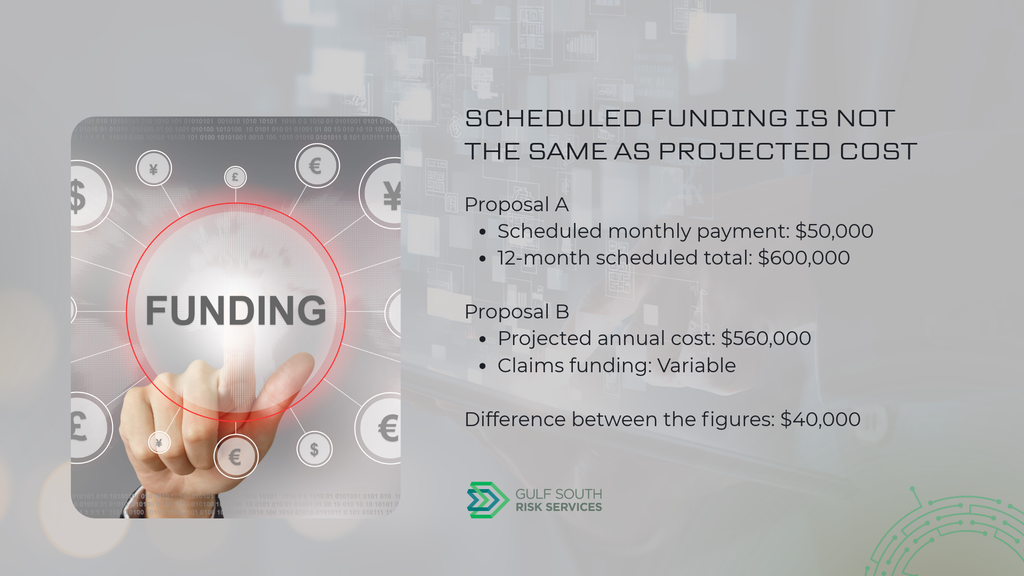
Hypothetical example: Proposal A schedules $50,000 each month, or $600,000 over 12 months. Proposal B projects $560,000 annually but leaves claims funding variable. The $40,000 difference is not demonstrated savings. Scheduled funding and projected cost are different measures, and neither figure alone explains the employer’s full contractual exposure.
Ask what a stated maximum includes, what it excludes, and which contract period applies. Do not assume the scheduled amount caps every liability or that the variable proposal will cost less.
Which stop-loss terms can change the employer’s exposure?
Stop-loss insurance reimburses qualifying employer claims under the policy’s terms. It is not an employee health insurance policy. Its value in a proposal comparison depends on the covered claims, attachment points, exclusions, policy period, and reimbursement conditions. Employers should assess the actual policy rather than treating stop-loss as a blanket limit on liability.
Specific stop-loss generally applies to eligible claims for an individual above a stated threshold. Aggregate stop-loss generally applies when eligible claims across the covered group exceed a specified total. An attachment point is the threshold beyond which the insurer may become liable under the policy.
Compare the claims incurred and paid periods, covered expenses, exclusions, reimbursement timing, and renewal provisions. If a proposal refers to a laser, ask whether an individual-specific higher threshold or exclusion applies and how it affects the protection being quoted.
One practical question is whether a claim incurred before termination but paid afterward qualifies under the relevant policy period. The answer depends on the policy wording. For a fuller explanation, see how stop-loss insurance works.
Scheduled payments and stop-loss coverage do not necessarily remove temporary cash-flow needs or uncovered liabilities. The National Association of Insurance Commissioners’ Stop Loss Insurance Model Act is a model for states to consider, not automatically binding law in Louisiana or elsewhere.
content.naic.org+1
Who controls surplus funds, claims data and renewal terms?
Surplus rights, reporting access, and renewal flexibility depend on the written agreements, not the funding label. Employers should establish who controls unused claims funding, what information they can receive, and which obligations continue when an arrangement renews or ends. These details can materially change the comparison.
Ask whether unused claims funding is refundable, credited toward a future period, or retained under specified conditions. Check how any balance is calculated, when it is reconciled, and whether a refund or credit depends on renewal. Do not treat claims funding surplus as guaranteed savings.
The agreement should also explain what happens to remaining funds and unpaid claims if the employer changes arrangements. Ask what claims information is available, how frequently it is reported, and what privacy or contractual restrictions apply.
Review health plan renewal terms, including notice periods, changes to rates or funding assumptions, and any conditions attached to continuing coverage. Employers planning a transition can also read what to expect in the first year of self-funding.
Request the exact contract provision behind any statement that unused funds belong to the employer. Do not assume unrestricted data access or a particular export or termination service.
What should a side-by-side proposal comparison include?
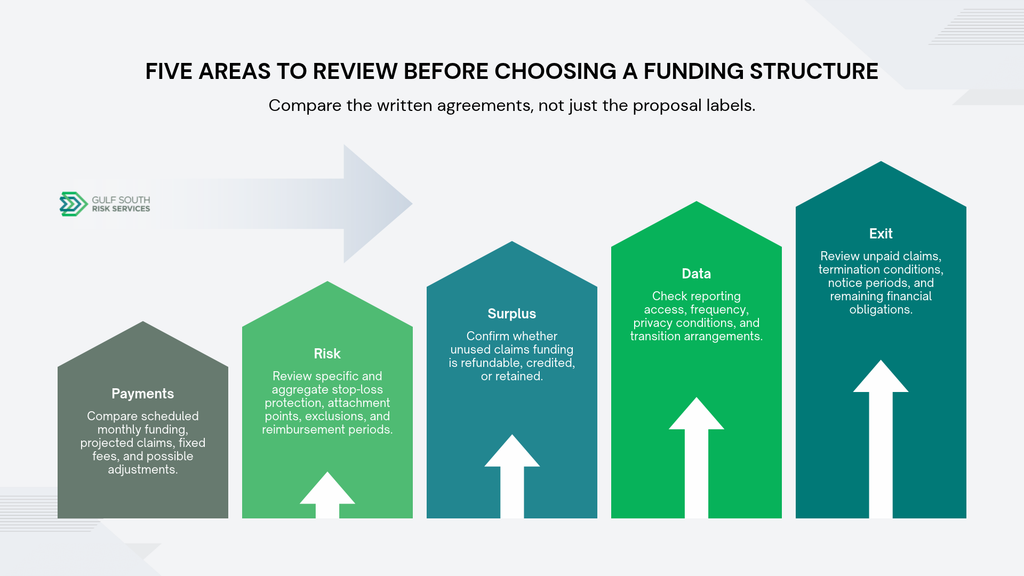
Employers should normalize the assumptions in each proposal and record contractual differences before choosing a funding structure. Compare payment schedules, risk protections, surplus treatment, data access, and exit conditions using the same questions. Where information is missing or cannot be compared, request a written explanation rather than filling the gap with an assumption.
Common comparison questions, not universal product characteristics:
| Comparison item | Level-funded proposal | Traditional self-funded proposal |
| Payments | Scheduled amount | Fixed fees plus variable claims |
| Risk | Verify policy and funding limits | Verify policy and funding limits |
| Surplus | Verify refund or credit terms | Verify reserve ownership and obligations |
| Data | Verify access and timing | Verify access and timing |
| Exit | Verify unpaid claims and conditions | Verify unpaid claims and conditions |
A proposal may use a different structure or terminology, so the table is a starting point rather than a description of every product. Ask the broker or administrator to explain blank fields, exclusions, and assumptions in writing.
An independent third-party administrator may support health plan administration, but employers should confirm the services included in the proposed agreement. Gulf South Risk Services describes itself as an independent TPA providing customized health administration.
Gulf South Risk Services
What other questions do employers ask about these arrangements?
Eligibility, employee experience, and renewal decisions depend on underwriting, plan design, and contract terms rather than a universal funding rule. Employers should confirm how a proposed arrangement applies to their group and workforce before assuming that a particular payment structure guarantees access, a refund, or renewal.
Is level funding available to every employer?
No. Availability depends on the product, underwriting, group circumstances, and applicable rules. There is no universal group-size cutoff that applies to every arrangement.
Can employees keep the same doctors after a funding change?
Possibly, but it depends on the provider network and benefit design. Confirm network participation and any plan changes before communicating an expected outcome to employees.
Is unused claims funding automatically returned each year?
No. Refunds or credits depend on the funding agreement, calculation method, timing, and any stated conditions. Ask for the relevant provision in writing.
How can employers make a more informed funding decision?
A sound comparison of a level funded health plan and traditional self-funding starts with consistent assumptions and a close review of written obligations. Employers should distinguish predictable payments from lower risk, then examine claims funding, stop-loss coverage, surplus rights, data access, and exit terms. No funding label guarantees a particular financial result.
Finance, HR, brokers, and appropriate legal or financial advisers can review the proposal together. For private-sector plans covered by the Employee Retirement Income Security Act (ERISA), the Department of Labor explains that employers have responsibilities when selecting and monitoring plan service providers. Its guidance recommends comparing providers using consistent information and reviewing their services and fees.
U.S. Department of Labor
Gulf South Risk Services is an independent third-party administrator offering health plan administration. Employers and brokers can discuss health-plan administration and clarify which services may fit their administrative needs.