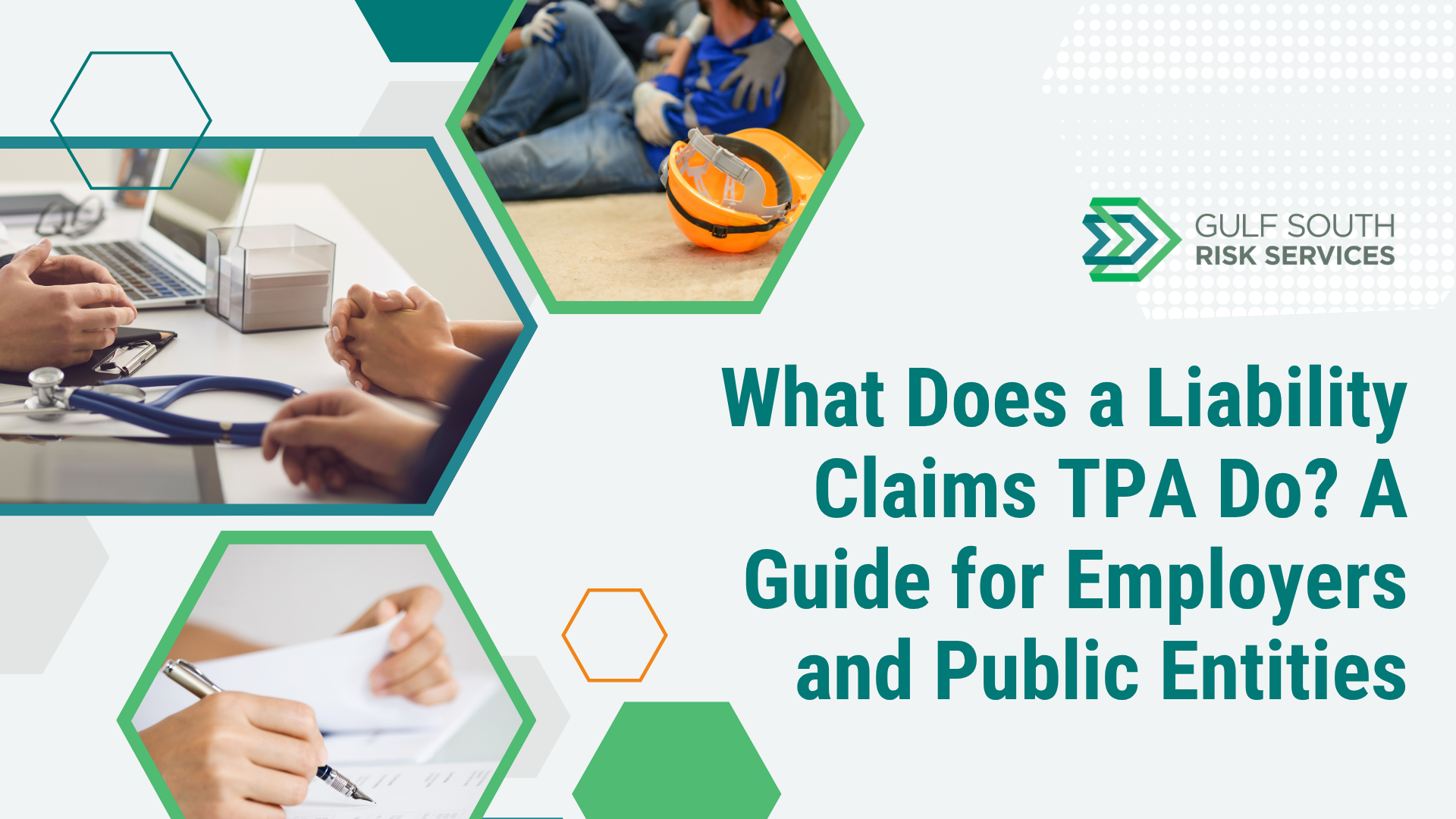
A liability claims TPA is a third-party administrator that manages assigned liability claims for an organization under an administration agreement. Its work may include claim intake, investigation, documentation, coordination, reporting, and settlement support. A TPA does not automatically insure the risk or have unlimited settlement authority. Its responsibilities depend on the contract, coverage arrangements, and applicable law.
For employers, municipalities, school districts, and other public entities, understanding these boundaries helps clarify who manages a claim, who funds it, and who makes important decisions.
Key takeaways:
- The administration agreement defines the TPA’s scope and authority.
- Claims handling, insurance funding, and legal representation are separate roles.
- Effective oversight depends on documentation, communication, and reporting.
What is a liability claims TPA?
A liability claims TPA manages claims on behalf of an organization without automatically assuming the financial risk of those claims. A third-party administrator may handle specific operational responsibilities while the employer, insurer, or other designated party retains funding and decision authority.
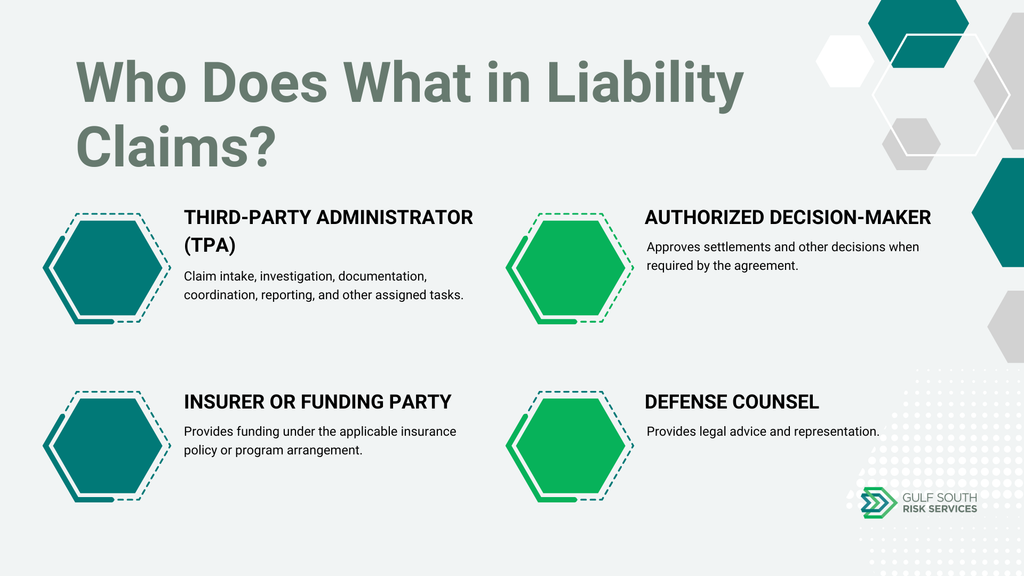
The roles are different. An insurer provides coverage under an insurance policy. A broker helps arrange insurance and advise the client. A defense attorney provides legal advice and representation. A TPA performs the administrative and claims-handling duties assigned to it.
The agreement should define the services provided, authority limits, reporting expectations, and escalation procedures. For a broader explanation, see third-party administrator responsibilities.
Which liability claims can a TPA administer?
A liability claims administrator may handle different claim types depending on its services, the client’s program, and the administration agreement.
| Claim type | Example exposure | What administration may involve |
| General liability claims | A visitor reports an injury on an organization’s premises | Intake, documentation, investigation, and coordination |
| Auto liability claims | A fleet vehicle is involved in a collision | Incident records, evidence gathering, claim evaluation, and reporting |
| Professional liability claims | A client alleges an error in a professional service | Document collection, coordination with relevant parties, and claim oversight |
These examples describe possible exposures, not findings of fault or confirmation of coverage. Each claim must be assessed using the relevant facts and applicable arrangements.
Public entity claims administration may involve municipalities, school districts, healthcare organizations, and other public or private organizations. Gulf South Risk Services identifies these organizations among the groups it supports. The specific liability lines accepted and responsibilities assigned should be confirmed directly with the administrator. Gulf South Risk Services describes its work with public and private entities and claims management programs.
What does the administrator handle during a claim?
A liability claims TPA may manage several operational tasks throughout a claim, from initial reporting through ongoing oversight and resolution.
Typical responsibilities can include:
- Intake and documentation: Recording the incident and organizing available information.
- Claims investigation: Gathering relevant records, statements, and other evidence.
- Evaluation and review: Assessing available information within the administrator’s assigned responsibilities.
- Reserve review: Updating estimates of potential claim costs when this responsibility is assigned.
- Coordination and reporting: Communicating with relevant parties and tracking claim developments.
A reserve is an estimate of potential future claim costs, not a final settlement amount or guaranteed prediction. Its purpose and calculation depend on the applicable claims process.
Gulf South Risk Services describes its claims administration and risk management services as including claim intake, investigation and evaluation, ongoing oversight, coordination, resolution, and reporting. The specific duties for an individual client should be established in the agreement.
Who controls coverage, funding and settlement decisions?
The TPA’s authority depends on the applicable contract and insurance or self-funded arrangement. Claims handling, financial responsibility, coverage decisions, and legal representation should not be treated as interchangeable.
| Party | Typical role | Important qualification |
| TPA | Handles assigned claims tasks and reporting | Authority is limited by the agreement |
| Insurer or responsible funding party | Provides funding under the applicable arrangement | Funding responsibilities depend on coverage or program terms |
| Authorized decision-maker | Approves settlements or other decisions when required | Approval limits and escalation rules vary |
| Defense counsel | Provides legal advice and representation | Legal responsibilities differ from administrative claims handling |
For example, a TPA may be authorized to negotiate or settle certain claims within an agreed limit. A claim exceeding that limit may require escalation and approval from another authorized party.
Employers and public entities should establish who can make decisions, which matters require approval, and how disputes or significant developments are escalated. They should also confirm who makes coverage decisions under the relevant policy or program. A TPA does not automatically have final authority over every claim.
What should employers and public entities ask before hiring?
Before appointing a liability claims administrator, employers and public entities should confirm how the service will work in practice.
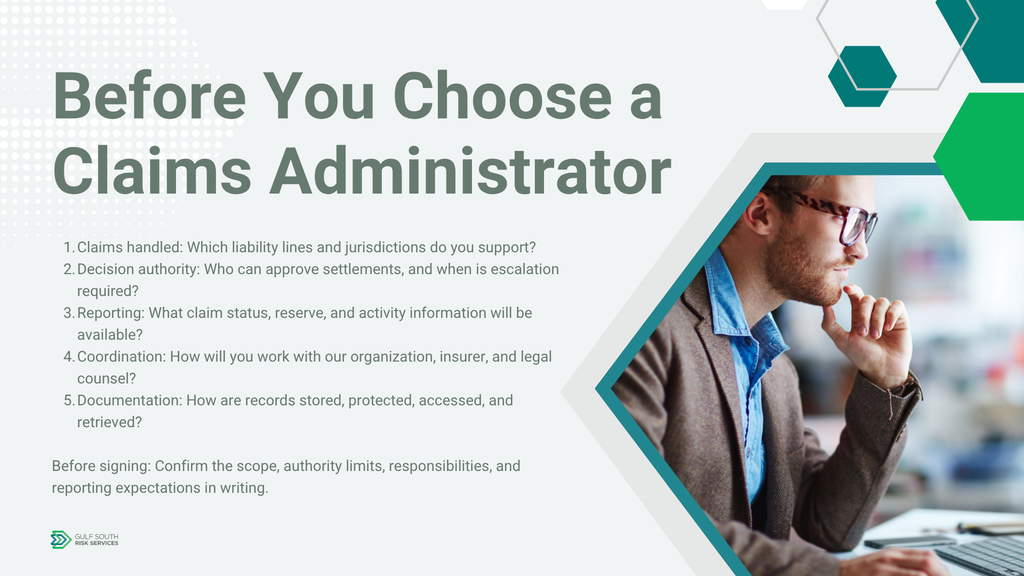
Ask these five questions:
- Which claim types and jurisdictions do you handle? Confirm whether the administrator accepts the liability lines relevant to your organization and the locations involved.
- What authority will you have? Ask who can approve settlements, when escalation is required, and how authority limits are documented.
- What reporting will we receive? Clarify how claim status, reserves where applicable, major developments, and outstanding actions will be communicated.
- How will you coordinate with counsel and insurers? Establish who contacts each party and who remains responsible for decisions.
- How will documentation be stored and shared? Confirm access arrangements, confidentiality safeguards, and how records can be retrieved when needed.
Public entities should also check applicable jurisdictional requirements and internal approval procedures. These can differ from those affecting private employers. Do not assume one process applies to every municipality or school district.
Gulf South Risk Services supports public and private organizations with claims administration and risk management. Its published positioning emphasizes structured oversight, coordination, and responsive communication. To understand whether its services fit a particular liability program, employers can review support for public and private organizations and discuss their requirements directly.
Frequently asked questions
Is a liability claims TPA an insurance company?
No. A TPA administers assigned claims responsibilities, while an insurer provides coverage under an insurance policy. The funding arrangement and responsibilities depend on the program and contract.
Can a TPA settle a claim without approval?
Sometimes, if the agreement grants settlement authority within defined limits. Other claims may require approval from an insurer, employer, or another authorized decision-maker. The agreement should explain these boundaries.
Do municipalities use liability claims administrators?
Yes. Municipalities and other public entities may use claims administrators to support claim handling, documentation, coordination, and reporting. The scope of the arrangement and any applicable public-sector requirements should be confirmed for each organization.
Conclusion
Choosing a liability claims TPA starts with understanding what the administrator will handle, which decisions it can make, and who retains financial responsibility. Employers and public entities should look for a clear agreement covering claim types, investigation, settlement authority, escalation, communication, and reporting.
These details help establish accountability before a claim occurs and give the organization a framework for reviewing the service over time. The right arrangement depends on the organization’s exposures, funding structure, and administrative needs.
Gulf South Risk Services provides claims administration and risk management support for employers and public and private organizations. To discuss your requirements, discuss liability claims administration.