A return-to-work program coordinates medically appropriate duties, communication, and follow-up after a workplace injury. It may help an employee resume suitable work and reduce avoidable time away, but results vary. Returning to work does not automatically close a workers’ compensation claim or end eligibility for all benefits.
For employers, the challenge is balancing recovery with operational needs while keeping everyone informed. A structured approach helps clarify what work is appropriate, who is responsible for decisions, and when the plan needs review.
Key takeaways
- Match duties to current medical restrictions and actual job demands.
- Maintain communication and reassess the plan after the employee returns.
- Treat the return date, recovery, and claim closure as separate milestones.
What is a return-to-work program?
A return-to-work program is a coordinated process that helps an injured employee resume suitable work when medically appropriate. Depending on the injury and available duties, the employee may return to their regular position, take on modified duties, or work a transitional assignment during recovery.
Modified duty means adjusting tasks, hours, or responsibilities to accommodate current work restrictions. Transitional duty is a temporary work arrangement intended to support the employee’s transition back to regular duties or another suitable role.
For example, an employee who cannot perform heavy lifting may be able to complete certain administrative tasks instead. Any proposed arrangement must reflect the employee’s restrictions, actual job demands, and applicable requirements.
The U.S. Department of Labor identifies timely coordination, job modifications, and communication among workers, employers, and healthcare providers as important elements of return-to-work strategies. Federal return-to-work guidance provides broader background, although state workers’ compensation rules differ. A return-to-work program should support recovery, not pressure an employee to work before they are ready.
How can returning to suitable work affect a claim?
Returning to suitable work may affect lost workdays, wage-replacement benefits, and the overall progress of a workers’ compensation claim. The impact depends on the employee’s medical condition, available duties, earnings, and the rules governing the claim.
A suitable assignment can allow an employee to remain connected to the workplace while recovering. It may also help employers plan staffing and maintain communication. However, these potential benefits are not guaranteed, and a return to work does not necessarily shorten every claim.
Medical treatment and wage-replacement benefits are separate considerations. An employee may return to work while continuing approved treatment. If the employee earns less because they cannot yet perform their usual job, partial wage-replacement benefits may remain relevant under applicable state rules. Louisiana, for example, recognizes supplemental earnings benefits for certain workers who return to work but cannot earn at least 90% of their pre-injury wages. Eligibility depends on the individual circumstances and Louisiana law. Louisiana workers’ compensation guidance explains relevant rights and responsibilities.
Effective workers’ compensation claims administration considers return-to-work planning alongside medical coordination, benefit administration, documentation, and ongoing claim review. The employee’s return date alone does not establish full recovery, close the claim, or automatically end eligibility for benefits.
Who coordinates the return-to-work process?
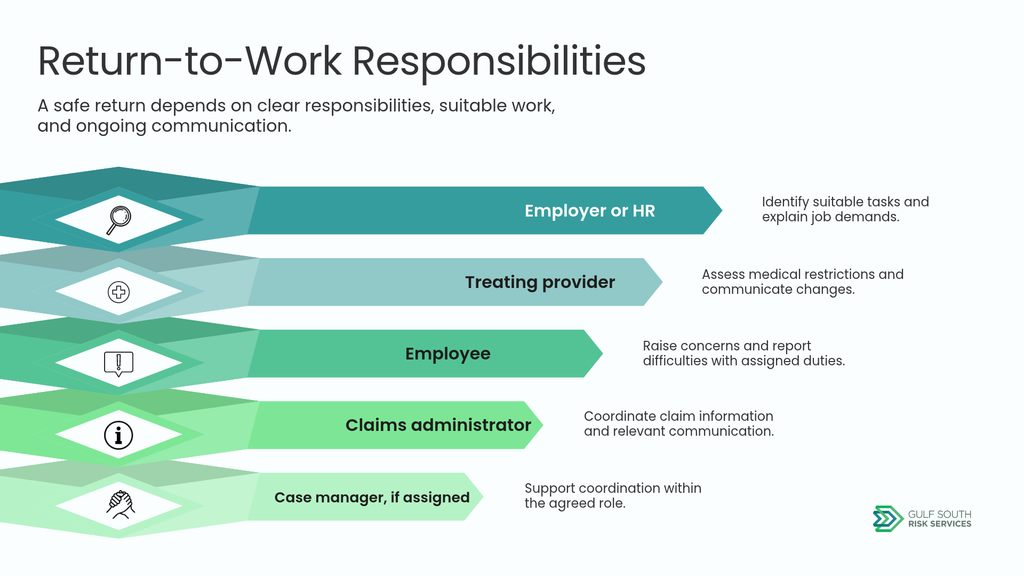
A successful return-to-work process depends on clearly defined responsibilities. The employer, employee, treating provider, claims administrator, and case manager, when assigned, may each contribute to planning and follow-up.
| Participant | Main responsibility |
| Employer or HR | Describe actual job duties, identify potentially suitable tasks, and communicate the proposed plan. |
| Employee | Share concerns about assigned duties and report difficulties through the agreed process. |
| Treating provider | Assess the employee’s condition and communicate medical restrictions or changes. |
| Claims administrator | Coordinate claim information, communication, and applicable benefit administration within its role. |
| Case manager, when assigned | Help coordinate communication and services within the scope of the assignment. |
The employer understands the physical demands and practical requirements of the workplace. The treating provider addresses medical restrictions. The claims administrator helps coordinate relevant information, but does not replace the provider’s clinical judgment.
Gulf South Risk Services provides workers’ compensation administration that includes claims oversight, medical management coordination, communication, and reporting. Its workers’ compensation administration services support the broader claims process. The specific responsibilities involved in return-to-work coordination depend on the program and the parties’ roles.
What does a practical modified-duty plan include?
A practical modified-duty plan describes what the employee can safely do, under what conditions, and how the arrangement will be reviewed. It should use current medical restrictions and a realistic description of the proposed job, rather than relying on a generic light-duty label.
Consider a hypothetical warehouse employee whose treating provider has restricted lifting. The employer reviews available tasks and identifies inventory record updates that do not require the restricted lifting, provided the actual duties have been assessed and are suitable.
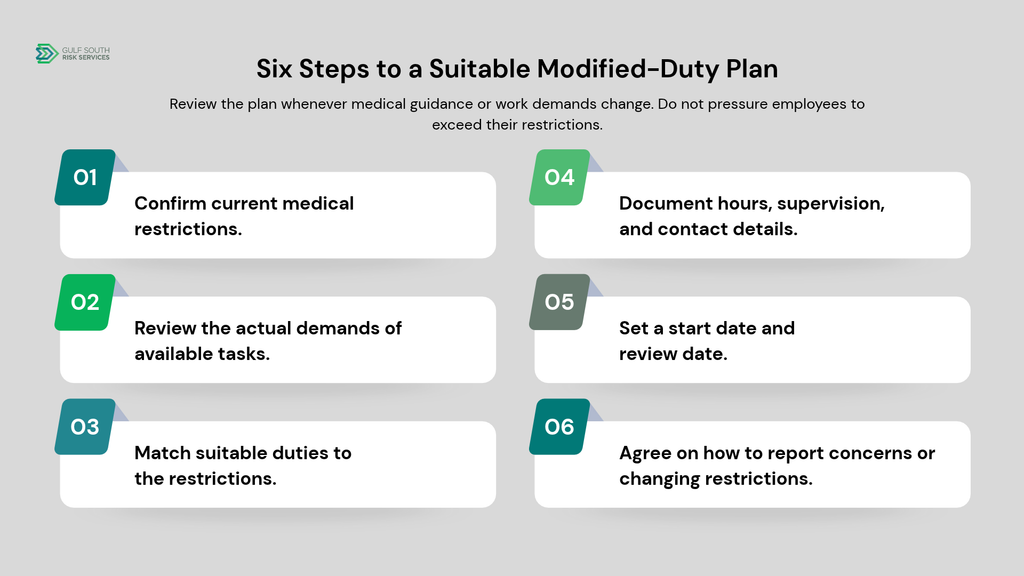
The written plan should identify:
- Current restrictions: Document the provider’s instructions and any relevant limitations.
- Suitable tasks: Describe the proposed duties and confirm they fit those restrictions.
- Hours and schedule: Record the proposed work hours, breaks, and any applicable limitations.
- Supervisor and contact: Identify who assigns work and whom the employee should contact with concerns.
- Start and review dates: Record when the arrangement begins and when its suitability will be reassessed.
- Escalation process: Explain what the employee and supervisor should do if duties cause difficulty or restrictions change.
The plan should be reviewed when medical guidance, job demands, or the employee’s ability to perform the work changes. If no suitable duties are available, the employer should coordinate with the claims administrator and appropriate advisers rather than inventing a role that conflicts with restrictions.
How should employers measure progress and avoid mistakes?
Employers can assess a return-to-work program by tracking whether suitable work is offered, whether the return is sustained, how many lost workdays occur, whether further absences arise, and whether communication is timely. These measures provide useful context, but they do not prove that a program caused a particular outcome.
Comparisons should account for differences in injury type, severity, job requirements, and workforce circumstances. A program handling more serious injuries may have different results from one covering less complex claims.
Common mistakes include vague job descriptions, pressure to exceed restrictions, limited follow-up, and assuming that returning to work means the claim is closed. Supervisors should know the agreed restrictions and reporting process. Employees should have a clear way to raise concerns without being encouraged to continue duties that may be unsuitable.
Employment obligations can also intersect with workers’ compensation and leave requirements. The Americans with Disabilities Act (ADA) may require reasonable accommodation for a qualified employee with a disability, depending on the circumstances. Not every workplace injury automatically qualifies as a disability under the ADA. Employers should assess applicable federal and state requirements with appropriate advisers. Equal Employment Opportunity Commission guidance explains reasonable accommodation principles.
Connecting return-to-work measures with claims oversight and reporting can help employers identify communication gaps and review program performance over time.
Frequently asked questions
Does returning to work close a workers’ compensation claim?
No. An employee may return while receiving medical treatment or remaining eligible for certain benefits. Claim closure and benefit eligibility depend on the circumstances and applicable state rules.
What if no suitable modified duty is available?
The employer should document the available work, communicate with the claims administrator, and consider appropriate next steps with qualified advisers. Do not assign duties that conflict with current restrictions.
Who decides which duties are medically appropriate?
The treating provider addresses medical restrictions, while the employer describes the actual job and proposed tasks. The parties should coordinate to determine whether the duties fit the restrictions. Questions about benefits or employment obligations should be directed to the claims administrator and appropriate advisers.
Build a more coordinated return-to-work process
A well-managed return-to-work program connects medical restrictions, suitable duties, clear communication, and regular review. It gives employers a practical framework for supporting injured employees without treating a return date as proof of complete recovery or claim closure.
For employers and brokers, the next step is to review how return-to-work planning fits into the wider claims process, including medical coordination, documentation, and ongoing oversight. Gulf South Risk Services provides workers’ compensation administration and claims support tailored to organizational needs.
To discuss your workers’ compensation program, contact Gulf South Risk Services.