Two TPAs may offer claims processing, eligibility administration, reporting, and member support while operating under very different ownership structures. Understanding the independent TPA vs carrier-owned TPA distinction can help brokers and employers evaluate how an administrator may affect vendor choice, plan design, technology, and service.
Neither structure is automatically right for every employer. An independent TPA may provide greater freedom to build a benefits ecosystem around the employer’s strategy, while a carrier-owned TPA may offer a more integrated administrative structure. The right choice depends on the plan’s priorities, the vendors required, and how much flexibility the broker and employer need.
What Is an Independent TPA?
An independent TPA is a third-party administrator that operates separately from an insurance carrier. Its ownership structure may allow it to work with different vendors, networks, technology platforms, and plan strategies, depending on its capabilities and agreements.
For a self-funded health plan, this can give brokers and employers more options when building the administrative structure. Possible components include a pharmacy benefit manager (PBM), PPO network, stop-loss provider, care management program, and technology platform.
However, independent does not mean unrestricted. Each independent third-party administrator has its own capabilities, contracts, technology, and vendor relationships.
Gulf South Risk Services identifies itself as an independent TPA and states that its model allows brokers and employers to work with multiple PBM, PPO, stop-loss, and technology partners.
What Is a Carrier-Owned TPA?
A carrier-owned TPA is an administrator owned by or affiliated with an insurance carrier. It may operate within a broader carrier ecosystem that includes established networks, technology, administrative systems, and other benefit services.
This structure can appeal to employers that prefer a more consolidated approach. Having several administrative components connected through one organization may reduce the number of separate vendor relationships an employer needs to coordinate.
At the same time, some carrier-owned administrator arrangements may have closer connections to the carrier’s existing networks, systems, or preferred vendors. The extent of those relationships varies, so employers should ask exactly which components are flexible and which are required.
The important distinction is structural, not qualitative. A carrier-owned administrator is not automatically less flexible, just as an independent TPA is not automatically better.
How Does Ownership Affect the TPA Relationship?
Ownership can influence the environment in which a TPA operates. It may affect organizational priorities, vendor relationships, technology choices, and how plan components are assembled.
An independent TPA may have more freedom to assemble different vendors around an employer’s needs. A carrier-owned TPA may operate within a larger ecosystem with established administrative relationships.
Ownership does not tell you whether the administrator is good. It tells you something about the structure in which the administrator operates.
For brokers and employers, this distinction is useful when comparing TPAs. Instead of treating ownership as a quality score, use it as one factor in understanding how the administrator may fit into the broader benefits strategy.
Which TPA Model Offers More Plan Design Flexibility?
Independent TPAs may offer more plan design flexibility, but actual capabilities depend on the administrator.
A self-funded health plan can involve several connected decisions, including network configuration, pharmacy benefits, stop-loss, cost containment, technology, and member support. An administrator’s operating structure can affect how easily those components can be combined.
Gulf South specifically positions flexibility as part of its independent model. Its website states that brokers and employers can build customized solutions using different PBM, PPO, stop-loss, and technology partners.
A carrier-owned TPA may also support customized plan designs. The relevant question is not simply whether customization exists, but how much choice is available and what conditions apply.
Why Does Flexibility Matter in a Self-Funded Health Plan?
Flexibility matters because a TPA for self-funded health plans may need to coordinate several independent components rather than one bundled insurance product.
These can include:
- Claims administration
- PPO or provider network arrangements
- PBM services
- Stop-loss coverage
- Utilization management
- Care management
- Reporting
- Member support
- Technology
A flexible administrative structure can make it easier for the employer and broker to evaluate these components individually.
How Does TPA Ownership Affect PBM, PPO, and Stop-Loss Choices?
This is one of the most practical differences to investigate when comparing TPAs.
An independent TPA may support a broader range of vendor relationships, allowing employers and brokers to evaluate different PBMs, PPO networks, stop-loss providers, and technology partners. Gulf South states that its model supports multiple options in each of these areas.
Vendor choice can matter because employers may have different priorities for pharmacy strategy, provider access, cost management, risk protection, and reporting.
Vendor flexibility gives the broker and employer more ability to build the administrative ecosystem around the plan rather than accepting one pre-set combination.
Carrier-owned TPAs may also work with outside vendors in some arrangements. Brokers should therefore ask which vendors are required, which are optional, and what happens if the employer wants to change a vendor later.
Can Employers Choose Their Own PBM With an Independent TPA?
Sometimes, yes, depending on the TPA and its vendor relationships.
Gulf South states that employers and brokers can select PBM partners that align with plan design, cost control, and pharmacy benefit strategies. Its technology and vendor integration model is designed to connect multiple plan components rather than require one platform.
The same question should be asked about PPO networks, stop-loss providers, and other vendors. Independence can create additional options, but the actual choices available are determined by the administrator’s capabilities and contracts.
How Do Independent and Carrier-Owned TPAs Differ in Technology?
Technology differences often come down to how many systems an administrator can connect and how those systems exchange information.
Some carrier-owned TPAs may use a standardized technology ecosystem designed around the carrier’s existing infrastructure. An independent TPA may be able to integrate a broader range of external platforms, depending on its technical capabilities.
Gulf South describes its approach as a hub-and-spoke model. Gulf South serves as the central administrative hub connecting PBMs, PPO networks, stop-loss providers, and technology platforms into a coordinated structure.
For an employer, the practical question is whether the technology supports useful reporting, reliable data exchange, efficient administration, and the vendors selected for the plan.
Why Does TPA Ownership Matter to Benefits Brokers?
For a TPA for brokers, the relationship needs to extend beyond claims administration. Brokers may need an administrator that supports their plan strategy, communicates clearly, provides useful reporting, and works within the broker’s client relationship.
Gulf South’s broker-focused model specifically emphasises supporting broker relationships, consistent communication, responsive support, and flexible vendor selection.
A broker should be able to recommend a plan strategy based on the employer’s needs rather than redesigning the strategy around the administrator’s preferred structure.
The TPA should fit the broker’s strategy instead of forcing the broker to redesign the strategy around the administrator.
This is particularly relevant when choosing a TPA for an employer with multiple vendors or a customized self-funded plan.
Does an Independent TPA Replace the Benefits Broker?
No.
The TPA generally handles administrative and operational functions, while the broker or benefits consultant typically advises the employer on benefits strategy and maintains the broader client relationship.
An independent TPA can work alongside the broker rather than replacing that role. Gulf South states that its independent model is designed to support brokers while maintaining client relationships.
Brokers evaluating an administrator should therefore ask how communication works after implementation, who handles escalations, how reporting is shared, and how the TPA supports broker-client discussions.
Does an Independent TPA Provide Better Service?
Not automatically.
Ownership does not guarantee responsiveness, claims accuracy, implementation quality, member support, or reporting quality. These factors need to be evaluated separately.
Brokers and employers should ask about:
- Dedicated contacts
- Response processes
- Claims oversight
- Escalation procedures
- Reporting
- Member service
- Implementation support
Gulf South identifies responsive service, clear communication, and broker and employer support as part of its service model. Those are Gulf South attributes, rather than universal characteristics of independent TPAs.
The same evaluation should apply to any carrier-owned administrator.
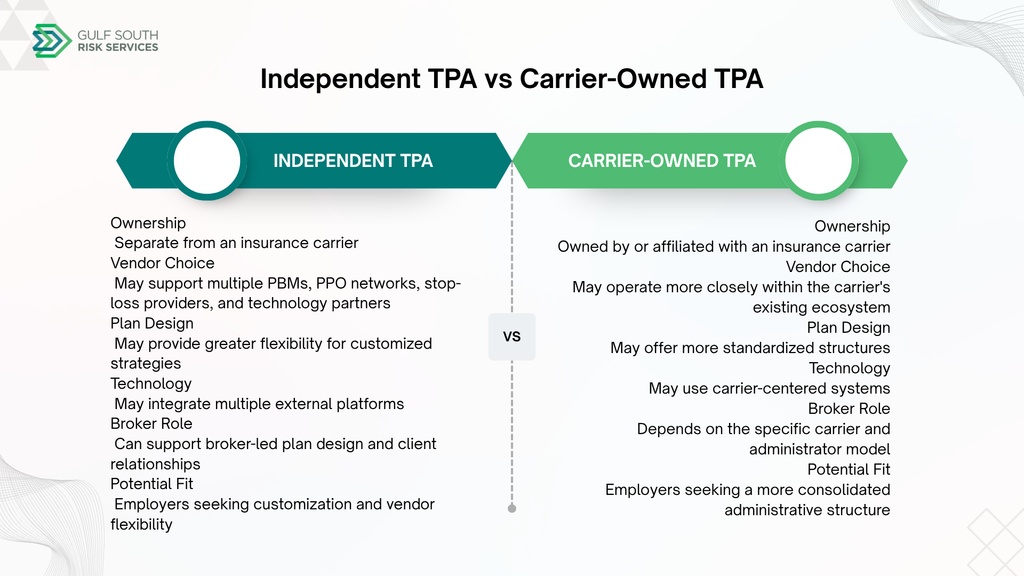
Independent TPA vs Carrier-Owned TPA at a Glance
| Factor | Independent TPA | Carrier-Owned TPA |
| Ownership | Separate from insurance carrier | Owned by or affiliated with carrier |
| Vendor choice | May support broader vendor selection | May be more closely tied to carrier ecosystem |
| Plan design | Often emphasizes customization | May use more standardized plan structures |
| Technology | May integrate multiple outside platforms | May use carrier-centered technology |
| Broker role | Can support broker-led plan design | Depends on carrier/admin model |
| Administration | Flexible ecosystem possible | Bundled ecosystem may be possible |
| Potential fit | Employers seeking customization or flexibility | Employers seeking a more integrated carrier structure |
These are general structural tendencies, not universal rules. Capabilities vary by TPA and carrier.
When Might an Independent TPA Be a Better Fit?
An independent TPA may be worth considering when the employer or broker prioritizes:
- Vendor flexibility
- Customized plan design
- Ability to evaluate multiple PBMs or PPOs
- Flexible stop-loss relationships
- Technology integration
- Broker-led strategy
- Individualized administration
This does not mean an independent model is automatically the right choice. The administrator still needs to demonstrate that it can support the employer’s operational requirements.
For more general guidance on choosing a TPA, see How to Choose the Right Third-Party Administrator.
When Might a Carrier-Owned TPA Be a Better Fit?
A carrier-owned TPA may be worth evaluating when an employer:
- Prefers a bundled administrative model
- Is comfortable using the carrier’s network and systems
- Values a consolidated ecosystem
- Has an existing carrier relationship that fits the plan strategy
- Does not require extensive vendor customization
A carrier-owned structure can offer a familiar or integrated approach for some organizations. The relevant question is whether the available network, technology, vendors, reporting, and service model meet the employer’s requirements.
The right choice depends on what the employer values more: flexibility, standardization, integration, or a particular combination of those factors.
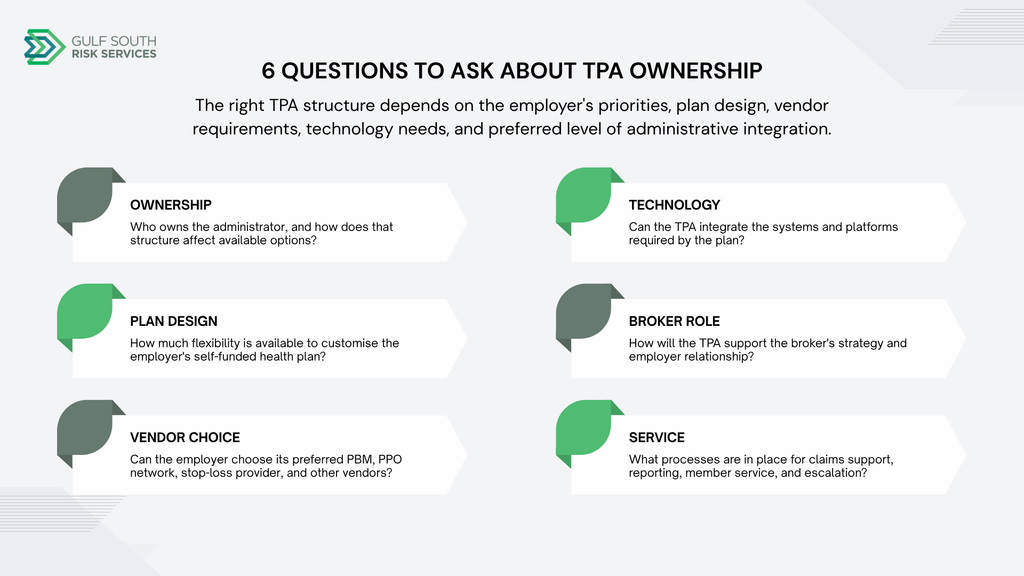
What Questions Should Brokers and Employers Ask Before Choosing Either Model?
Use this checklist when comparing an independent TPA with a carrier-owned TPA:
- Who owns the TPA?
- Which vendors are required?
- Can we choose our own PBM?
- Can we choose among PPO networks?
- How is stop-loss coordinated?
- Are there required technology platforms?
- How much flexibility is available in plan design?
- What reporting is available?
- Who handles member support?
- How are claims escalations managed?
- How does the TPA work with the benefits broker?
- What happens if we want to change a vendor later?
These questions help move the evaluation beyond administrative fees and brand recognition. They also help employers determine whether the self-funded health plan administrator can support the actual structure being considered.
How Gulf South Risk Services Approaches Independent TPA Administration
Gulf South Risk Services operates as an independent third-party administrator serving brokers, employers, and plan members. Its stated model supports flexible plan design, multiple PBM and PPO options, stop-loss coordination, technology integration, and broker-aligned administration.
The company’s hub-and-spoke model places Gulf South at the centre of the administrative structure, connecting the employer and broker with PBM, PPO, stop-loss, and technology partners. The stated goal is to provide a coordinated administrative experience while allowing the plan to use different specialist vendors.
For brokers, Gulf South also emphasizes communication, responsive support, reporting, and collaboration throughout the life of the plan.
This model gives employers and brokers a specific alternative to evaluate when considering the broader question of how TPA ownership may affect plan administration.
Common Mistakes and Misconceptions
Several assumptions can make a TPA comparison less useful:
- All TPAs operate the same way. Ownership and operating models differ.
- Carrier-owned means inflexible in every case. Vendor and plan flexibility vary.
- Independent automatically means better. Service and capabilities still need to be evaluated.
- The lowest administrative fee is the best choice. Total plan fit matters beyond the fee.
- Vendor requirements are minor details. Required PBMs, PPOs, technology, or stop-loss relationships can affect plan strategy.
- Technology compatibility can be addressed later. Integration should be considered before implementation.
- Ownership guarantees service quality. It does not.
An informed comparison looks at structure, capabilities, contracts, service, reporting, and the employer’s actual plan requirements.
Related Topics to Understand
Before making a decision, brokers and employers may also want to review the distinction between a TPA and an insurance carrier, the operational responsibilities of a TPA, and the broader process for evaluating administrators.
Gulf South’s existing content on TPA vs Insurance Carrier: What Is the Difference? can help clarify the different roles. Its health plan administration information also explains how claims processing, eligibility, provider networks, PBMs, stop-loss, reporting, and member support fit together.
Conclusion: Which TPA Structure Fits Your Organization?
The key difference in the independent TPA vs carrier-owned TPA comparison is not simply branding. Ownership structure can influence how an administrator approaches vendor relationships, plan design, technology, and broker involvement.
Neither model is automatically right for every employer. The better approach is to identify the plan’s priorities first, then evaluate which structure provides the appropriate combination of flexibility, integration, administration, reporting, and service.
Gulf South Risk Services offers an independent model for brokers and employers that want to evaluate multiple plan components within a coordinated administrative structure.
Discuss your plan or broker partnership with Gulf South Risk Services