
Changing a third-party administrator is a significant operational decision for an employer with a self-funded health plan. A delayed response, difficult claim, or isolated administrative error does not automatically mean the relationship should end. However, recurring problems with communication, reporting, claims administration, vendor coordination, member support, or plan strategy may indicate that the current arrangement no longer fits.
So, when should an employer switch TPAs? A useful way to approach the decision is to ask whether the problem can be fixed, whether it has been escalated, and whether the issue is ultimately structural. This creates a practical Fix → Escalate → Replace framework.
The goal is not to switch at the first sign of friction. It is to identify persistent problems, understand their causes, and determine whether the current TPA can support the employer’s needs now and in the future.
Does One Bad Experience Mean You Need a New TPA?
No. One difficult claim or service problem is not enough by itself to determine that an employer needs a new administrator.
TPA relationships involve many moving parts. An isolated error may be corrected through normal service channels. The more important question is whether a problem is part of a recurring pattern.
Employers can ask:
- Is this a one-time issue?
- Has the same problem happened before?
- Has the TPA acknowledged the issue?
- Has corrective action been taken?
- Is the problem affecting employees, the broker, vendors, or internal staff?
- Is the issue operational, or does it reflect a structural limitation?
The decision to switch third-party administrators should be based on the overall relationship rather than one frustrating experience.
The decision should be based on recurring problems and strategic fit, not isolated frustration.
What Should an Employer Document Before Evaluating a Change?
Before changing TPAs, employers can track recurring issues and the steps already taken to address them.
This may include service complaints, response times, administrative errors, unresolved claims issues, reporting limitations, member complaints, vendor-coordination problems, and escalation history.
Documentation does not need to be complicated. The purpose is to establish a clear record of what is happening and whether attempts to resolve the issue have been effective.
This also gives the employer and benefits broker a stronger starting point when choosing a new TPA.
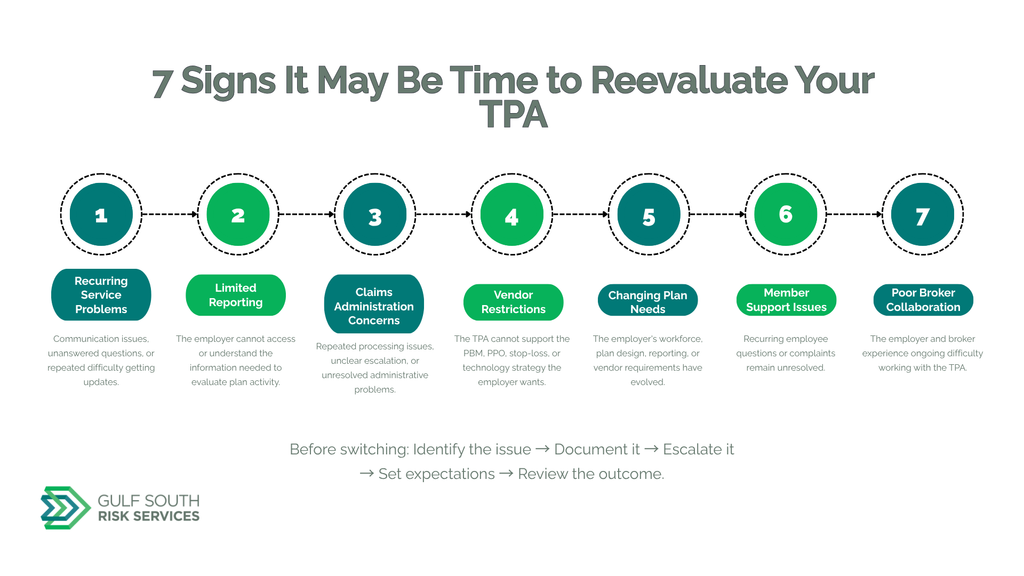
Sign 1: Service and Communication Problems
When Does Poor TPA Communication Become a Reason to Reevaluate the Relationship?
It may be worth evaluating alternatives when communication problems become persistent and interfere with administration.
Examples can include repeated difficulty reaching the appropriate contact, unanswered questions, inconsistent information, unclear ownership of issues, slow escalation, or regularly having to chase updates.
A TPA service issue does not necessarily mean the administrator is unsuitable. Employers should first establish whether there is a clear process for resolving the problem and whether the TPA responds when concerns are raised.
A useful service structure should make it clear who handles routine questions, who manages claims escalations, who owns implementation or vendor issues, and who becomes involved when a problem continues.
Gulf South Risk Services emphasizes responsive service and relationships with employers, brokers, and plan members. For any employer reviewing its current arrangement, service responsiveness can be one of several factors used to assess whether the employer TPA relationship is working as expected.
Should Employers Expect a Dedicated Point of Contact?
A clear service structure is important, but the exact contact model varies by TPA.
The key issue is whether the employer and broker understand how questions and escalations are handled. A dedicated contact may be part of one administrator’s model, while another may use a broader service team.
The employer should know who owns each type of issue and how unresolved concerns move through the organization.
Sign 2: Reporting and Transparency
When Is TPA Reporting No Longer Good Enough?
Reporting may need to be reevaluated when an employer cannot obtain or understand the information needed to manage its plan.
A self-funded health plan requires employers to make informed decisions about plan performance and administration. Depending on the plan, useful reporting may help employers examine claims activity, utilization, major cost drivers, trends, plan performance, and vendor activity.
Limited reporting does not automatically mean an employer needs to change third-party administrator. First, determine whether additional reports, explanations, or reporting support are available.
Gulf South’s group health plan administration services include reporting and analytics intended to provide employers with greater visibility into utilization, cost drivers, and performance trends.
If an employer cannot understand what is happening inside the plan, it becomes harder to make informed decisions about what should change.
What Reporting Questions Should Employers Ask Their Current TPA?
Employers and brokers can ask:
- What reports are available?
- How often can they be reviewed?
- Can the employer understand the major cost drivers?
- Can the broker access the information needed for plan strategy?
- Are reports explained when questions arise?
- Can important trends be identified over time?
The answers can help distinguish a reporting problem that can be corrected from a broader limitation in the administrator’s capabilities.
Sign 3: Claims Administration Problems
When Should Claims Administration Concerns Trigger a TPA Review?
Repeated claims-administration problems may justify a closer review of the current TPA relationship.
Claims administration is a core responsibility of a self-funded health plan TPA. Employers may have reason to investigate further when they see repeated processing problems, unclear communication about claim status, inconsistent follow-up, unresolved administrative issues, or unclear escalation procedures.
It is important to separate claim cost from claims administration quality. An expensive claim does not by itself show that a TPA has performed poorly. The question is how the claim was administered and communicated.
Gulf South describes its health plan administration services as including claims processing, eligibility management, reporting, and member support.
How Can Employers Evaluate Claims Service More Objectively?
Employers can consider whether:
- Claims are handled consistently
- Problems are clearly explained
- Escalations are documented and addressed
- The employer understands the process
- Members receive appropriate support
- The broker has enough information to assist
Looking at these factors together provides a more useful picture than focusing on an individual claim.
Sign 4: Limited Vendor Flexibility
When Do Vendor Restrictions Become a Reason to Consider Another TPA?
Vendor restrictions may become a concern when they prevent the employer and broker from carrying out the plan strategy they want to pursue.
An employer’s needs can change over time. It may want to reconsider its pharmacy benefit manager, PPO network, stop-loss provider, technology partners, or cost-containment approach.
If the current TPA cannot support the desired approach, the employer should determine why. The limitation could be temporary, contractual, technical, or structural.
TPA vendor flexibility matters when the employer needs choices that its current administrative model cannot accommodate.
Gulf South’s independent model supports integration with multiple PBM, PPO, stop-loss, and technology partners. That makes vendor coordination a relevant consideration for employers reviewing their administrative structure.
Vendor limitations matter when they prevent the employer and broker from executing the plan strategy they actually want.
Does Every Employer Need Maximum Vendor Flexibility?
No.
Some employers may prefer a more standardized or bundled administrative model. That approach may fit their needs.
The relevant question is whether the existing structure supports the employer’s current priorities. Flexibility has value when an employer needs it. It is not automatically a requirement for every organization.
Sign 5: The TPA No Longer Fits the Plan Strategy
Can an Employer Outgrow Its Current TPA?
Yes, in the sense that an employer’s needs can change over time.
An administrator that worked well several years ago may still provide competent administration but no longer align with the employer’s current requirements.
Changes that may prompt a review include workforce growth, new locations, more complex plan design, different cost-containment strategies, new vendors, greater reporting needs, changes in broker strategy, or expanded member-support requirements.
Size alone does not determine whether a TPA is still a good fit. The issue is whether the administrator can support the plan as it exists today and as the employer expects it to develop.
When Should Employers Reevaluate Strategic Fit?
There is no single required review point. Employers may choose to reassess the relationship during renewal planning, major plan redesign, vendor changes, broker changes, organizational growth, persistent administrative problems, or consideration of new cost-containment approaches.
These events can provide an opportunity to ask whether the current third-party administrator still matches the employer’s strategy.
Sign 6: Member Experience Is Suffering
When Should Member Complaints Become a TPA Concern?
Occasional member questions are normal, but repeated complaints may warrant closer review.
Employers can look for patterns involving difficulty getting answers, confusion about claims, unclear benefits information, recurring service problems, or unresolved escalations.
The member experience is an important part of evaluating administration because employees interact with the plan through claims, eligibility, benefits information, and support.
Gulf South includes member support within its administrative services and describes support for plan members dealing with claims and benefits information.
Employers should therefore evaluate not only how the TPA serves management, but also how members experience the administration of the plan.
Sign 7: The Broker-TPA Relationship Is Not Working
Why Should Employers Consider the Broker’s Experience With the TPA?
The broker’s experience can provide another useful perspective on the administrative relationship.
Benefits brokers may work closely with the TPA on plan strategy, vendor relationships, implementation, reporting, issue resolution, and renewal planning.
If communication between the broker and TPA is consistently difficult, that friction can affect the employer’s ability to address issues and make informed plan decisions.
Gulf South describes its approach as broker-aligned and works with brokers while supporting their ongoing client relationships.
The employer remains the decision-maker. Broker feedback is one input that can help inform the evaluation.
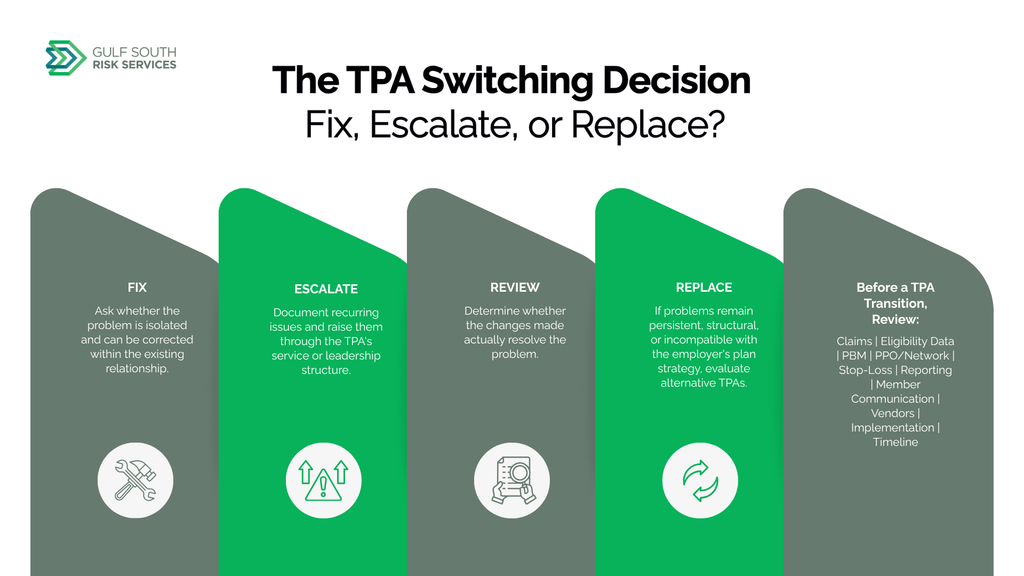
Fix or Switch?
Which TPA Problems Can Sometimes Be Fixed Without Switching?
Many operational problems can potentially be addressed without replacing the administrator.
Examples include unclear contact structures, reporting-format questions, service expectations that were never clearly established, isolated administrative errors, communication gaps, and training issues.
A practical approach is:
Identify → Document → Escalate → Set Expectations → Review
First, identify the problem clearly. Document recurring examples and raise the issue through the appropriate service or leadership channel. Establish what improvement is expected, then review whether the issue has actually been resolved.
This approach gives the existing TPA a reasonable opportunity to correct operational problems before the employer considers a TPA transition.
Which Problems May Point to a More Structural Mismatch?
Persistent or structural problems may justify evaluating alternatives.
Examples may include an inability to support required vendors, continuing service problems after escalation, reporting capabilities that do not meet the plan’s needs, an operating model that conflicts with the employer’s strategy, unavailable plan-design flexibility, or recurring administrative problems that remain unresolved.
The distinction is important. If the problem can be corrected through a service change, additional reporting, or clearer communication, replacing the TPA may not be necessary.
If the issue is built into the administrator’s operating model, however, the employer may need to consider whether another administrator is a better fit.
Before Making the Change
What Should Employers Review Before Switching TPAs?
Employers should understand the operational requirements of a third-party administrator transition before selecting a replacement.
Key areas to review include:
- Current TPA agreement and timing
- Existing vendor relationships
- Active claims
- Eligibility data
- PBM arrangements
- PPO or network arrangements
- Stop-loss coordination
- Reporting and data transfer
- Member communication
- Implementation responsibilities
- Broker responsibilities
- Transition timeline
The employer should also understand who will coordinate each part of the change.
Gulf South’s published broker guidance highlights areas such as transition timelines, ownership of implementation, eligibility-file transfer, vendor coordination, employee communication, testing, and ongoing support.
Applicable agreements and transition requirements should be reviewed with the appropriate advisors rather than assumed.
When Is the Best Time to Switch TPAs?
It depends on the employer’s plan year, contracts, vendors, and implementation requirements.
There is no universal best time to make a change. Employers may need to consider renewal timing, open enrollment, stop-loss arrangements, vendor transitions, data transfer, testing, and member communications.
The transition should be planned with the employer, benefits broker, incoming TPA, and relevant vendors so that responsibilities and timing are understood before implementation begins.
Evaluating the Replacement
What Should Employers Look for in a New TPA?
The replacement administrator should be evaluated against the specific problems and requirements that led to the review.
1. Service
How accessible is the team, and how are routine questions and escalations handled?
2. Claims Administration
How are claims processed, reviewed, communicated, and escalated?
3. Reporting
Will the employer and broker have the information needed to understand plan activity and support decisions?
4. Vendor Flexibility
Can the administrator support the desired PBM, PPO, stop-loss, and technology strategy?
5. Member Support
How are employee questions, claims concerns, and benefits-information needs addressed?
6. Implementation
Is there a structured process for transferring data, coordinating vendors, communicating with members, and preparing for go-live?
7. Strategic Fit
Can the TPA support the employer’s future plan direction as well as its current requirements?
What Should a TPA Transition Process Include?
A well-planned transition generally needs clear ownership, communication, data transfer, vendor coordination, testing, and go-live support.
A useful framework is:
Planning → Communication → Data and Eligibility Transfer → Vendor Coordination → Testing → Go-Live Support
Gulf South’s published guidance for brokers discusses transition planning, including who manages the process, how eligibility files are transferred, how vendors are coordinated, how employees are informed, and how implementation updates are communicated.
This framework should not be treated as a universal contractual process. The exact requirements will depend on the employer, vendors, existing arrangements, and incoming administrator.
How Gulf South Risk Services Approaches TPA Partnerships
Gulf South Risk Services positions itself as an independent third-party administrator serving employers, brokers, and plan members.
Its published services include self-funded health plan administration, claims processing and oversight, reporting, member support, and coordination across PBM, PPO, stop-loss, and technology relationships.
Gulf South also emphasizes broker-aligned administration, responsive service, and long-term relationships. Its independent structure allows it to work with multiple vendor relationships rather than presenting administration as a single bundled carrier ecosystem.
For employers considering a change, the relevant comparison is not simply whether a TPA is independent or carrier-owned. Employers should compare potential administrators against the specific service, reporting, claims, vendor, member-support, and implementation needs that prompted the review.
That includes understanding how the administrator would fit into the employer’s existing vendor ecosystem and how a third-party administrator transition would be managed.
Common Mistakes or Misconceptions
Employers can avoid several common mistakes when evaluating their current TPA:
- Switching because of one isolated service problem
- Assuming every expensive claim is a TPA failure
- Evaluating only administrative fees
- Failing to document recurring issues
- Not escalating problems before deciding to move
- Ignoring member experience
- Ignoring broker feedback
- Failing to assess vendor restrictions
- Choosing a new TPA without understanding implementation
- Waiting until transition planning becomes rushed
- Assuming a new TPA automatically solves every plan problem
- Failing to define what better administration should look like
A replacement should be evaluated against specific requirements rather than simply being presented as an alternative to the current provider.
Conclusion
Knowing when should an employer switch TPAs requires more than identifying something that went wrong. The stronger question is whether the problem is isolated, whether it can be corrected, and whether the current administrator remains aligned with the employer’s needs.
The Fix → Escalate → Replace framework provides a practical way to approach that decision. Employers can identify recurring issues, document them, raise concerns through the appropriate channels, and review whether meaningful improvement occurs. If service problems, reporting limitations, claims-administration concerns, vendor restrictions, member-support issues, or strategic mismatches remain unresolved, evaluating alternatives may be appropriate.
The transition itself also deserves careful planning. Employers and brokers should understand data, eligibility, vendors, claims, member communication, implementation responsibilities, and timing before making a change.
Employers and brokers evaluating their current TPA arrangement can speak with Gulf South Risk Services about self-funded health plan administration, vendor integration, reporting, and transition considerations.