What is subrogation? Subrogation is the process of seeking recovery from a third party that may be responsible for a loss after a claim has been paid. In simple terms, one party pays a claim and may then seek reimbursement from the party responsible for causing the loss.
In claims administration, this creates an important question: Is someone other than the employer, plan, or insurer financially responsible for some of this loss?
A strong claims process does not only ask, “What do we owe?” It can also ask whether another party may be responsible for part of the cost.
Subrogation can arise in workers’ compensation, auto liability, property damage, and other liability situations. The exact rights and procedures depend on the type of claim and applicable law.
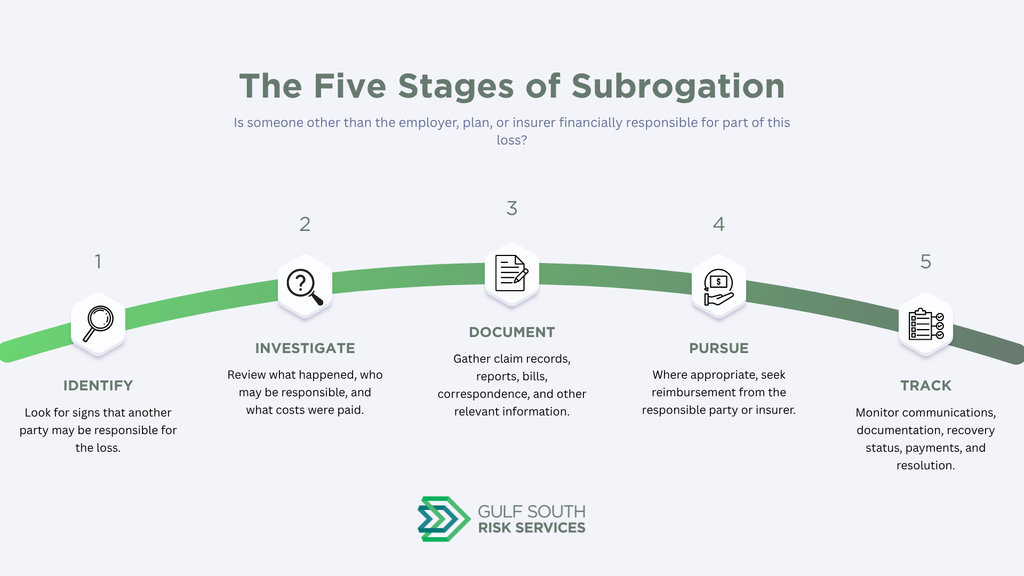
A practical way to understand the subrogation process is through five stages:
Identify → Investigate → Document → Pursue → Track
What Is Subrogation in Simple Terms?
Subrogation allows a party that paid a claim to seek recovery from another party that may have been responsible for causing the loss.
For example, imagine an employee is injured in a vehicle accident while performing work duties. The employer’s workers’ compensation program may handle the employee’s claim. If another driver may have caused the accident, there may also be a potential recovery opportunity involving that third party.
This does not mean recovery is automatic. The facts, applicable law, available evidence, and structure of the claim program all matter.
The same basic concept can apply to insurance subrogation involving property damage or liability claims. A claim may initially be handled through one program while another party may ultimately have financial responsibility for some or all of the loss.
Subrogation is therefore a recovery process, not a separate type of claim.
How Does Subrogation Fit Into Claims Administration?
Subrogation in claims administration is part of the broader process of reviewing, investigating, managing, and resolving claims.
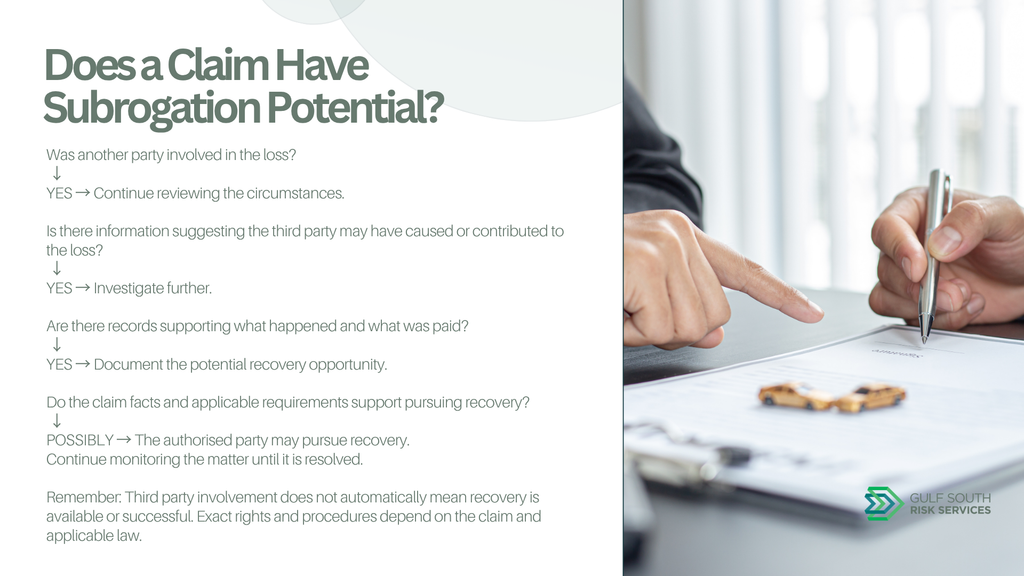
A claims administrator may need to consider questions such as:
- What caused the loss?
- Was another party involved?
- Is there evidence of third party responsibility?
- Has the claim been paid?
- Are there potential recovery rights?
- What documentation supports those rights?
Claims administration is not only about paying valid claims. It can also involve identifying legitimate recovery opportunities.
This is particularly relevant when an employer, plan, or insurer has already paid costs that may be connected to another party’s actions.
Stage 1: Identify
How Are Potential Subrogation Opportunities Identified?
A possible subrogation opportunity may become visible during the normal review of a claim.
Information that may help identify an opportunity includes:
- Initial claim reports
- Incident investigations
- Witness statements
- Police or accident reports
- Medical records
- Property damage documentation
- Employer reports
- Photos and other claim records
Consider a workplace vehicle accident. An employee is injured while driving for work, and another driver may have caused the crash. The workers’ compensation claim is one part of the situation. The involvement of another driver may also prompt a review for potential third party recovery.
The presence of another party does not automatically establish liability or create a successful recovery claim. It simply means the claim may warrant further investigation.
What Is an Example of Subrogation?
A simple example is a work related vehicle accident involving another driver.
An employee is injured while performing work duties. The employer’s workers’ compensation program pays eligible claim costs. During the investigation, information suggests another driver may have caused the accident.
The claims administrator may then investigate whether the circumstances create a potential recovery opportunity.
This illustrates the central question behind claims subrogation: Could someone other than the employer or its claims program be responsible for some of the loss?
Stage 2: Investigate
What Does the Claims Administrator Investigate?
Once a potential opportunity is identified, the claims administrator may gather information to understand what happened and whether recovery may be appropriate.
The investigation may consider:
- How the loss occurred
- Who may be responsible
- What damages or expenses were paid
- What coverage may exist
- What evidence supports potential recovery
Potential sources of information can include employer records, accident reports, witness statements, photographs, invoices, medical information, correspondence, and other claim documentation.
The earlier a possible recovery issue is recognized, the easier it may be to preserve relevant information. However, early identification does not guarantee a particular recovery result.
Does Every Workers’ Compensation Claim Involve Subrogation?
No.
Many workplace injuries do not involve a responsible third party. Workers compensation subrogation becomes relevant when the facts suggest another party may have contributed to the loss and applicable law provides a recovery right.
For example, an employee injured by a condition that does not involve another responsible party may have no subrogation opportunity.
A different situation may arise when an employee is injured in an accident caused by another person or business. That claim may warrant additional review.
The important point is that third party involvement does not automatically guarantee recovery.
Stage 3: Document
Why Is Documentation Important in Subrogation?
Documentation helps establish what happened, who may be responsible, and what costs were associated with the claim.
Depending on the claim, useful records may include:
- Incident reports
- Claim notes
- Medical bills
- Property repair records
- Accident reports
- Correspondence
- Payment records
- Photographs
The goal is not to create a separate paperwork exercise. Documentation is part of normal claims administration and can help support the review of a potential recovery opportunity.
For example, if property was damaged in an incident involving another party, records showing the damage, repair costs, responsible parties, and payments may help the administrator evaluate the situation.
Stage 4: Pursue
What Happens When a Subrogation Opportunity Is Confirmed?
When a recovery opportunity is supported by the facts and applicable requirements, the claims administrator or another authorized party may pursue reimbursement from the responsible third party or that party’s insurer.
The claim recovery process may include:
- Notification
- Exchange of documentation
- Recovery discussions
- Coordination with legal counsel where necessary
- Settlement or reimbursement activity
Exact procedures vary significantly by claim type and jurisdiction. Employers and risk managers should therefore avoid assuming that one subrogation process applies to every claim.
Who Actually Pursues the Recovery?
It depends on the structure of the claim program.
A TPA may manage the process directly, coordinate with the employer, work with legal counsel, or involve another recovery specialist.
There is no single structure that applies to every organization or claim.
The important consideration is that responsibility for recovery should be clear. Employers and risk managers should understand who identifies potential opportunities, who investigates them, who communicates with third parties, and who tracks the matter through resolution.
Stage 5: Track
Why Does Subrogation Need Ongoing Follow Up?
Identifying a recovery opportunity is not enough. The matter may require continued follow up after the original claim has progressed.
A claims administrator may need to:
- Monitor communications
- Track outstanding documentation
- Update recovery status
- Reconcile payments
- Report progress
- Close the recovery matter when appropriate
Subrogation can remain active even after the original claim has otherwise progressed significantly.
This is one reason subrogation should be viewed as part of claims administration rather than as a completely separate activity.
How Long Does Subrogation Take?
There is no single timeline that applies to every subrogation matter.
The length of the process can depend on the claim type, the number of parties involved, available documentation, insurance coverage, negotiations, applicable law, and whether legal issues need to be addressed.
Some matters may be resolved relatively quickly. Others can require extended investigation and communication.
The important point for employers is to understand how potential recoveries are being tracked rather than assuming every matter will follow the same timeline.
What Are Common Examples of Subrogation?
Workers’ Compensation
An employee is injured in a work related vehicle accident caused by another driver. The workers’ compensation claim is handled through the employer’s program, while the circumstances may also create a potential third party recovery opportunity.
Auto Liability
An organization incurs costs following an accident, and another party may be responsible for causing the incident. The claim administrator may investigate whether recovery is appropriate.
Property Damage
A third party damages company property. The organization’s claim is initially handled through its coverage or claims program, while the responsible party may be pursued for eligible costs.
General Liability
A loss involves multiple parties, and another party may bear some responsibility. The claim administrator may review the circumstances to determine whether a recovery opportunity exists.
These examples illustrate potential subrogation situations. They do not mean recovery rights exist automatically.
Why Does Subrogation Matter to Employers and Risk Managers?
1. Cost Recovery
A successful recovery can allow eligible claim costs to be recovered from a responsible third party.
This does not mean every recovery opportunity will succeed, but identifying potential claims can help ensure they are properly considered.
2. Claims Accuracy
Subrogation encourages a complete review of who may be responsible for a loss.
The focus is not only on the amount paid. It also includes the circumstances behind the claim and whether another party may have financial responsibility.
3. Better Claims Oversight
A strong claims process considers both payment and potential recovery.
This gives employers and risk managers greater visibility into how claims are being handled from initial reporting through resolution and recovery activity.
4. Program Visibility
Employers and risk managers should understand where recovery opportunities may exist and how those matters are being handled.
Subrogation can therefore form part of broader risk management and claims oversight.
Can Subrogation Reduce the Cost of a Claim?
It can result in recovery of eligible claim costs when a responsible third party is identified and recovery is successful.
However, subrogation does not automatically reduce every claim cost. Recovery is not guaranteed, and recovered amounts do not necessarily affect every claim program in the same way.
The financial impact depends on the specific claim, program structure, applicable law, and outcome of the recovery effort.
What Is the TPA’s Role in Subrogation?
A third party administrator may support several parts of the subrogation process.
This can include:
- Identifying potential recovery opportunities
- Gathering documentation
- Coordinating communication
- Tracking recovery activity
- Reporting status
- Working with other parties involved in the recovery process
The role of a TPA depends on the structure of the program and the services agreed with the employer or organization.
Gulf South Risk Services currently identifies subrogation and property damage recovery among its claims administration capabilities. Its broader claims administration services include claim intake and documentation, investigation and evaluation, ongoing claims oversight, coordination, resolution, and reporting.
What Should Employers Ask a Claims Administrator About Subrogation?
Employers and risk managers can use the following questions when evaluating a claims administrator:
- How do you identify possible subrogation opportunities?
- Who is responsible for investigating them?
- How are potential recoveries documented?
- Who communicates with third parties?
- When is outside counsel involved?
- How is recovery activity tracked?
- What reporting is available?
- How are recovered amounts documented?
- What happens if recovery is not practical?
- How are jurisdiction specific requirements handled?
These questions can help employers understand how subrogation fits within the wider claims management process.
How Gulf South Risk Services Approaches Claims Administration and Subrogation
Gulf South Risk Services lists subrogation and property damage recovery as part of its claims related services. The company states that it helps clients manage and pursue property damage and workers’ compensation claims caused by third parties.
Its broader claims administration and risk management offering covers workers’ compensation, liability, casualty, and specialty claims, with services including intake, documentation, investigation, evaluation, ongoing oversight, coordination, reporting, and resolution.
For employers, brokers, municipalities, school systems, and other organizations, this places subrogation within the broader context of claims oversight rather than treating recovery as an isolated task. Gulf South also states that it supports organizations and public entities with claims administration and risk management services.
The specific approach to any claim will depend on the circumstances, program structure, and applicable requirements.
Common Mistakes or Misconceptions
Several misunderstandings can make subrogation harder to evaluate:
- Thinking subrogation is a type of insurance
- Assuming every claim has subrogation potential
- Assuming third party involvement automatically guarantees recovery
- Waiting too long to identify a possible recovery issue
- Failing to document third party involvement
- Treating subrogation as separate from claims administration
- Assuming the TPA is always the only party involved
- Expecting every recovery to happen quickly
- Assuming recovered amounts affect every claim program the same way
Understanding these points can help employers approach subrogation as one component of disciplined claims management.
Conclusion
What is subrogation? It is a recovery process that may allow a party that has paid a claim to seek reimbursement from another party that may be responsible for some or all of the loss.
In claims administration, the process can be understood through five stages:
Identify → Investigate → Document → Pursue → Track
Not every claim creates a recovery opportunity, and recovery is not guaranteed. However, reviewing claims for potential third party responsibility can be an important part of effective claims oversight.
For employers, brokers, and risk managers, the key question is whether the claims process considers both the cost of a loss and who may ultimately be responsible for it.
Gulf South Risk Services supports claims administration and risk management programs that include subrogation among its claims related capabilities. Employers and brokers can speak with Gulf South about claims administration, subrogation, and broader risk management support.