
Reporting a workplace injury starts the claims process, but it does not end the employer’s involvement. If you are asking what happens after a workers compensation claim is reported, the claim is typically reviewed, assigned, investigated, and monitored. The administrator may coordinate with the employer, injured worker, medical providers, and other parties while tracking documentation, treatment, work status, and other developments.
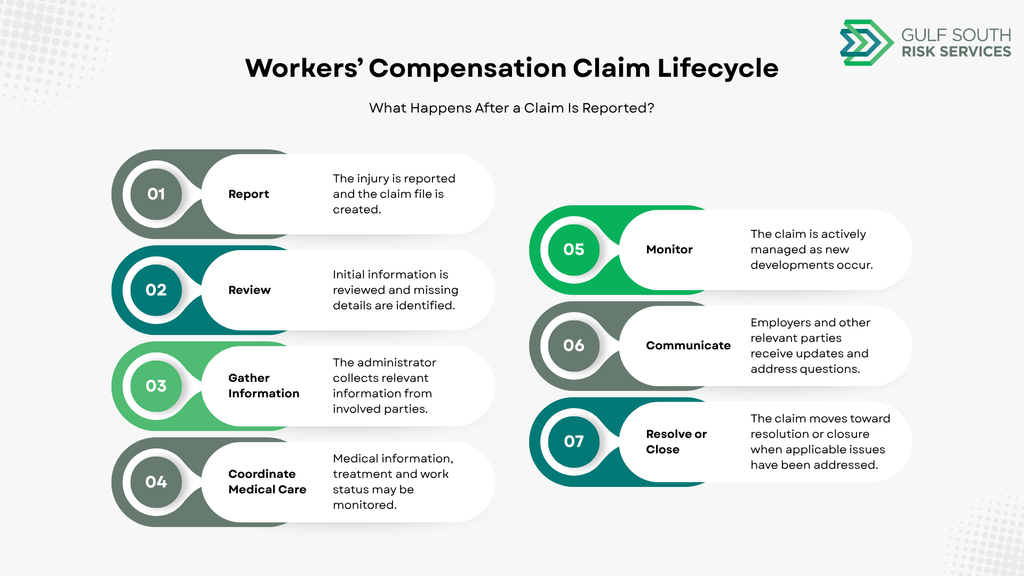
The workers compensation claim process varies by jurisdiction, claim type, employer program, and the facts of the injury. The lifecycle follows seven stages: report, review, information gathering, medical coordination, management, communication, and resolution or closure.
Step 1: The Claim Is Received and Set Up
Once an injury is reported, the claim is typically entered into the claims system and a claim file is created. The file may include employee and employer details, date of injury, incident description, initial medical information, and witness information when available.
This is the starting point for workers comp claim reporting. Intake requirements vary by program and jurisdiction. Reporting does not mean every relevant fact is already known.
Step 2: The Claim Is Reviewed
What happens first after a workplace injury claim is filed? The initial review generally comes next.
The claims administrator reviews the information available to understand what happened, identify missing details, determine what actions may be needed, and identify parties who may need to be contacted.
The review establishes what is known and what needs clarification, moving the claim into active management.
Step 3: Additional Information Is Gathered
A workers comp claim investigation may require information from the employer, injured worker, supervisor, witnesses, medical providers, and existing incident documentation.
The goal is to build an accurate record. Follow-up questions may be needed when information is incomplete or unclear. Fact gathering should not automatically be viewed as adversarial. It gives the administrator information needed for claim handling.
Step 4: Medical Care and Documentation Are Coordinated
What is medical management in workers’ compensation? Workers comp medical management involves coordinating and monitoring relevant medical information as a claim progresses.
Depending on the case, the administrator may track treatment information, review medical documentation, coordinate with providers, monitor work status, and follow claim-related medical developments.
Medical coordination can continue after the initial report, depending on the injury, treatment needs, work status, and other facts.
Gulf South Risk Services identifies medical management coordination, claims management, injury reporting and intake, cost control and risk mitigation, regulatory compliance support, and reporting and analytics among its workers’ compensation services.
Step 5: The Claim Is Actively Monitored
Claims administration is an ongoing process, not a one-time transaction.
Workers compensation claims management may continue for weeks, months, or longer depending on the claim. Monitoring can include new medical information, changes in work status, documentation updates, claim expenses, outstanding questions, and next steps toward resolution.
Step 6: Communication Continues With the Employer and Other Parties
Who communicates with the injured employee? This depends on the employer’s program, the claim, and the parties involved. A workers compensation TPA may communicate and coordinate with the employer, injured worker, medical providers, broker or risk advisor, and other involved parties as appropriate.
Employers should know their main claims contact, how updates are provided, how questions are escalated, and what reporting is available.
Gulf South describes its workers’ compensation approach as including responsive communication with employers and injured employees, coordination across stakeholders, and reporting throughout the claims lifecycle.
Step 7: The Claim Moves Toward Resolution or Closure
What happens before a workers’ compensation claim is closed? The claim may move toward resolution once relevant issues have been addressed and no further claim activity is required.
Potential factors include medical status, work status, outstanding documentation, financial activity, and legal or administrative requirements. Closure timelines vary, so employers should not assume that every claim will resolve in the same way or within the same period.
An initial medical visit does not necessarily mean the claim is complete.
What Should the Employer Do After Reporting the Claim?
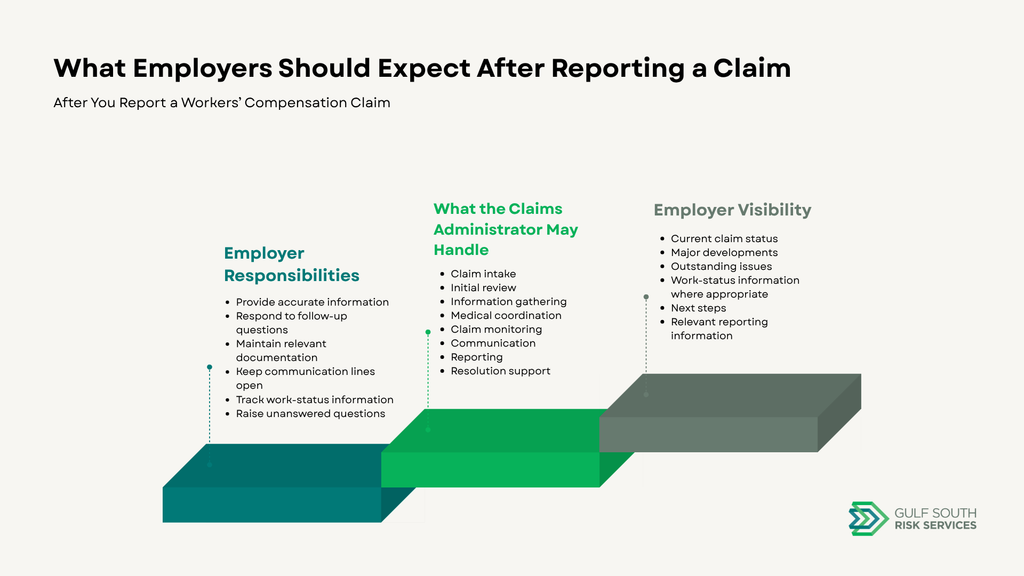
What should an employer do after reporting a claim? The employer should generally remain available to provide accurate information and respond to relevant follow-up questions.
A practical checklist includes:
- Provide complete and accurate information.
- Respond to follow-up questions.
- Maintain internal documentation.
- Keep communication lines open.
- Coordinate with the claims administrator.
- Track relevant work-status information.
- Escalate unanswered questions or concerns when needed.
These are general administrative practices, not jurisdiction-specific legal advice. Employers should follow the requirements that apply to their programs.
Why Does Prompt Communication Matter?
Prompt, complete communication can help the administrator maintain a clearer and more current claim file.
When information is delayed, missing, or unclear, additional follow-up may be needed. Clear communication can help identify outstanding questions, document developments, and keep relevant parties informed.
This does not guarantee lower claim costs or faster resolution. Its value is supporting accurate administration and oversight.
What Does a Workers’ Compensation TPA Do After a Claim Is Reported?
A workers compensation TPA may support the claim from intake through resolution. Its responsibilities can include claim intake, claims review, information gathering, medical coordination, ongoing claim oversight, communication, reporting, and resolution support.
For a broader explanation of the administration function, see How Workers Compensation Claims Administration Works. This article focuses on the chronological experience after a specific claim is reported, while that existing article explains the broader function.
What Should Employers Expect From Their Claims Administrator?
A useful framework is:
Clarity → Communication → Documentation → Oversight → Reporting
Employers should understand who manages the claim, how updates are communicated, how questions are handled, what documentation is available, and how the claim is monitored over time.
Reporting format, schedules, and responsibilities depend on the employer’s program and administrator.
How Long Does a Workers’ Compensation Claim Take?
How long does a workers’ comp claim take? It depends on the claim.
Factors can include injury severity, medical treatment, documentation, work status, claim complexity, and applicable jurisdictional requirements.
Some claims may resolve relatively quickly, while more complex claims can remain open much longer. There is no universal timeline for every workers’ compensation claim lifecycle.
Does Every Workers’ Compensation Claim Require the Same Level of Management?
No. Simple and complex claims may require very different levels of oversight, documentation, medical coordination, and communication.
A straightforward injury may require limited ongoing activity. A complex claim may involve continuing treatment, multiple information sources, changing work status, and additional documentation. The workers comp claim lifecycle provides a framework, but activity at each stage can vary.
What Information Should Employers Receive About an Open Claim?
Employers should have enough visibility to understand where a claim stands and what issues remain active.
Depending on the program and claim, this may include claim status, major developments, work-status information where appropriate, outstanding issues, next steps, and financial or reporting information as applicable.
Reporting packages and frequency can vary. Employers should clarify what information they will receive and how questions can be raised.
How Gulf South Risk Services Approaches Workers’ Compensation Claims Administration
Gulf South Risk Services provides workers’ compensation administration that includes claims management, injury reporting and intake, medical management coordination, cost control and risk mitigation, regulatory compliance support, and reporting and analytics.
At a high level, Gulf South describes its service framework as:
Program Assessment → Claims Setup & Process Design → Active Claims Management → Ongoing Optimization
This is a service framework, not the exact sequence every claim follows. Individual claims can require different levels of investigation, medical coordination, communication, monitoring, and reporting.
Common Mistakes and Misconceptions
Common assumptions include:
- Assuming reporting the claim ends the employer’s involvement
- Expecting every claim to follow the same timeline
- Treating fact gathering as adversarial
- Failing to respond to follow-up requests
- Assuming one medical visit means the claim is complete
- Ignoring relevant work-status updates
- Not knowing who the claims contact is
- Failing to escalate unanswered questions
- Assuming an expensive claim automatically reflects poor claims administration
- Expecting every claim to close quickly
Conclusion
Understanding what happens after a workers compensation claim is reported helps employers know what to expect after the initial injury report. Reporting starts the process, but active management continues through review, information gathering, medical coordination, monitoring, communication, and eventual resolution or closure.
The practical lifecycle is:
Report → Review → Gather Information → Coordinate → Monitor → Communicate → Resolve
The steps vary based on the claim, employer program, jurisdiction, and facts of the injury. Employers should understand who is handling the claim, what information is needed, how updates are communicated, and how the claim is monitored.
Employers and brokers can speak with Gulf South Risk Services about workers’ compensation claims administration and its approach to claims oversight, medical management coordination, reporting, and ongoing claim administration.