An ERISA plan document sets the governing terms of a plan covered by the Employee Retirement Income Security Act (ERISA). A summary plan description (SPD) explains those terms to participants in understandable language. For self-funded employers, these self-funded health plan documents must serve separate purposes and remain aligned.
Key takeaways:
- The governing document and participant summary serve different purposes.
- An SPD is not interchangeable with a benefits summary or insurance contract.
- Assign responsibility for accurate documents, amendments and required delivery.
The comparison and review steps help employers identify gaps early. Review each item carefully. Keep records current.
What is an ERISA plan document for a self-funded health plan?
For an ERISA-covered self-funded health plan, the ERISA plan document is the written instrument establishing the plan and its governing terms. Self-funded means the employer directly funds benefits rather than buying insurance to pay claims. ERISA health plan requirements depend on the arrangement, not funding alone.
The document may address eligibility, benefits, funding, claims procedures, administration and amendments. Federal law requires a written instrument and named plan fiduciaries. 29 U.S.C. § 1102
A vendor agreement, stop-loss policy or benefits brochure is not automatically the complete governing document. Ask which current instrument and amendments establish the terms. Governmental plans and most church plans generally fall outside ERISA Title I, subject to applicable exceptions. U.S. Department of Labor
How does the plan document differ from the SPD and SBC?
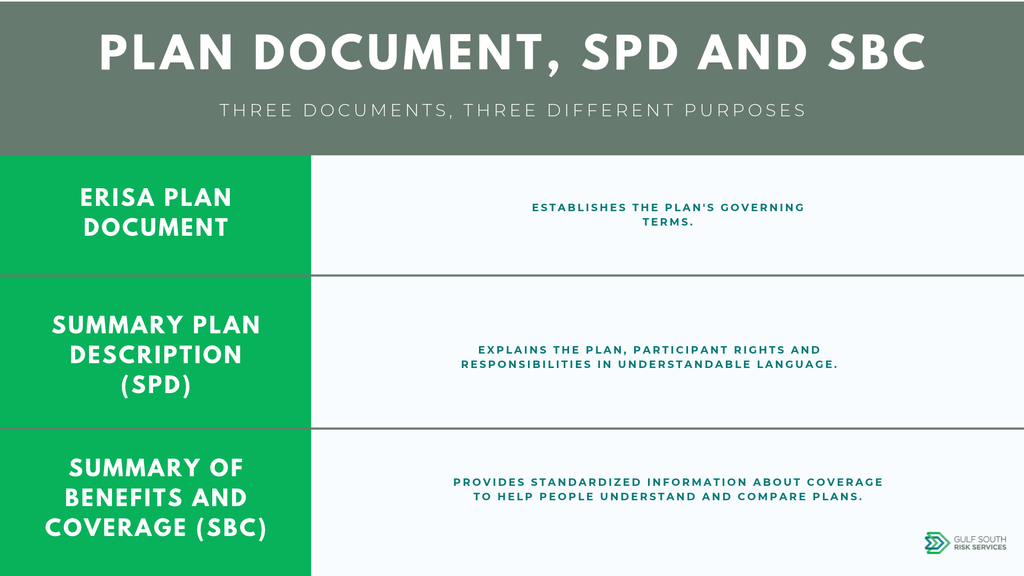
The plan document sets governing terms; the summary plan description (SPD) explains the plan to participants; and the Summary of Benefits and Coverage (SBC) gives key standardized coverage information. These documents serve separate functions and are not interchangeable under federal law. ERISA § 102 DOL plan information
| Document | Main purpose | Review question |
| Plan document | Establishes governing terms | Is this the current governing version? |
| SPD | Explains the plan to participants | Does it satisfy SPD requirements? |
| SBC | Summarizes coverage in a standardized format | Does it match current coverage? |
An SPD must be accurate and clearly readable. A combined document may do both if compliant. The SBC generally stands apart here. DOL SPD guidance SBC guidance
What information should the documents explain?
The documents should clearly explain how the plan is established, what benefits are available and how participants use them. Self-funded health plan documents and SPDs cover related subjects, but their required contents and purposes differ. Check this plan’s legal requirements carefully.
Categories to check include eligibility, benefits and exclusions, contributions or funding, administration contacts, claims and appeals, summary of material modifications, and participant rights. Verify each category against current plan requirements. The SPD must include specified disclosures about plan operation, eligibility, claims procedures and remedies. 29 U.S.C. § 1022
Can employees find eligibility rules and appeal instructions? The how self-funded health plan claims are processed article explains the workflow. Confirm written procedures match the current plan terms.
Who is responsible for providing and updating the SPD?
Plan administrator responsibilities under the governing plan instrument include furnishing the SPD to participants and beneficiaries as required under applicable ERISA provisions. Hiring a third-party administrator (TPA) does not automatically make it the named plan administrator or transfer every employer responsibility. 29 U.S.C. § 1102
Employer or plan sponsor maintains it. The named administrator handles disclosures. A TPA performs services; its title does not determine its legal role.
Generally, an SPD is due within 90 days after an individual becomes a participant, or within 90 days after a beneficiary first receives benefits. A new plan has 120 days after becoming subject to ERISA. A summary of material modifications has separate timing rules under ERISA. 29 U.S.C. § 1024 DOL disclosure guide
What should employers check before relying on their plan documents?
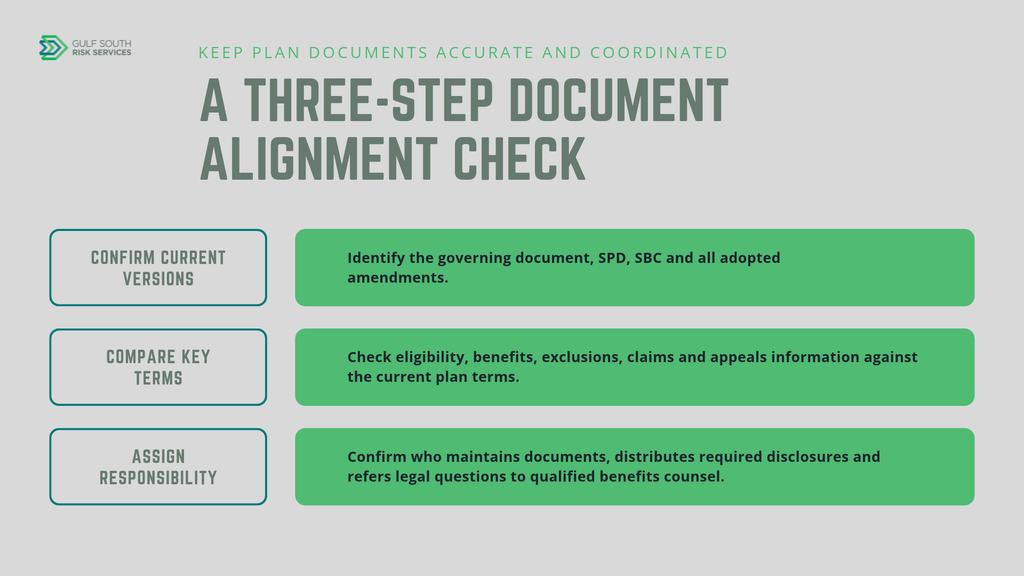
Employers should compare governing materials with participant explanations and actual administration before relying on them. This review identifies inconsistencies, confirms document ownership and directs legal questions to qualified benefits counsel. This matters when teams make decisions and communicate with participants.
Check versions and amendments; compare eligibility, benefits and claims; confirm distribution and record ownership.
An eligibility amendment might not appear in the SPD. Investigate and coordinate the documents; no decision follows.
Gulf South Risk Services operates as an independent TPA. See health-plan administration support and its first-year self-funding guide. Gulf South service information
What else do employers ask about ERISA documents?
ERISA document disclosure requirements distinguish document requests, wrap materials and operational records. Employers should identify which documents the plan maintains, who handles requests and whether delivery methods meet applicable federal disclosure rules. Keeping a file is not the same as furnishing required information.
Can a participant request a copy of the governing plan document?
Yes. Participants and beneficiaries may request specified documents in writing. The administrator generally has 30 days to provide the latest SPD and other documents governing plan operation. This does not grant access to every vendor record. DOL disclosure guide
Does every employer need a wrap document?
No. A wrap plan document supplements benefit materials. The need depends on plan structure and existing documents. Counsel can assess.
Is keeping an SPD on file enough?
No. The administrator must furnish required materials. Electronic access must meet applicable disclosure rules. DOL plan information
How can employers move from document review to coordinated administration?
Employers can begin by identifying the current governing ERISA plan document, SPD, SBC, amendments and related materials. Confirm who owns each document, who distributes participant disclosures and who should resolve differences. This article provides general information, not legal advice. Refer legal questions to qualified benefits counsel.
A clear document set helps employers and providers use consistent plan information. Gulf South Risk Services can discuss operational coordination for self-funded health plans. Employers and brokers can discuss health-plan administration coordination with the team. Assign an owner to each document question promptly.