A self funded health plan claims process follows a structured workflow involving the healthcare provider, third party administrator (TPA), employer, provider network, and, when applicable, a stop loss carrier. The employer funds covered claims, but the employer typically does not review or approve individual medical claims. Instead, the TPA handles claims administration, payment processing, and reporting. Understanding how claims move from provider billing through review, payment, reporting, and possible stop loss reimbursement can help employers evaluate plan performance. Gulf South Risk Services helps employers understand these processes and the administrative responsibilities involved in self funded health plans.
Step 1: An Employee Receives Medical Care
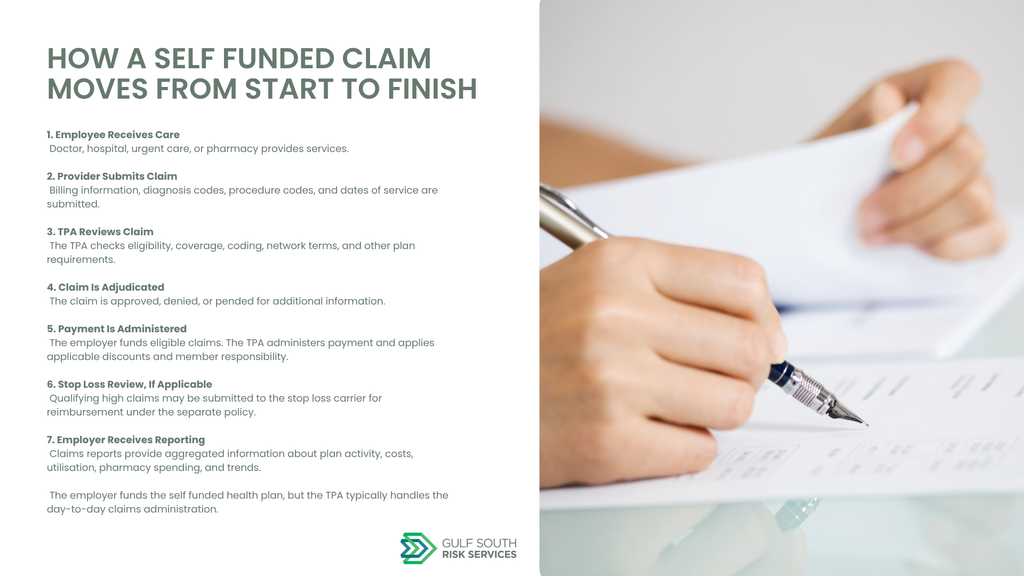
The claims process begins when an employee or covered dependent receives healthcare services. This may include a doctor visit, hospital treatment, urgent care, or a prescription filled at a pharmacy.
The healthcare provider or pharmacy typically verifies eligibility and checks the member’s identification information. If applicable, the provider also confirms whether the provider participates in the plan’s provider network.
At this stage, the employer is not reviewing the medical service or deciding whether it should be covered. The provider and health plan’s administrative systems begin the process of determining how the service will be handled.
The employer funds the plan, but the initial claim information comes from the provider or pharmacy.
Step 2: The Provider Submits the Claim
The provider submits a medical claim electronically to the appropriate claims administrator. The claim contains information needed to determine how the service should be processed.
This can include diagnosis codes, procedure codes, dates of service, provider information, charges, and other billing details. Pharmacy claims generally follow a separate process involving the pharmacy benefit manager (PBM).
The claim is sent to the TPA or claims administrator, not directly to the employer’s HR or finance team. This separation allows trained claims professionals and automated systems to apply the plan’s administrative rules.
Provider billing starts the formal health insurance claims process, while the TPA manages the administrative review.
Step 3: The TPA Reviews the Claim
The TPA reviews the claim against the applicable plan requirements, eligibility information, network arrangements, and provider contracts. This stage is often called claims adjudication, which means the process of determining how a claim should be handled under the health plan.
The review may consider:
- Whether the employee or dependent was eligible on the date of service
- Whether the service is covered under the plan document
- Whether the medical coding is consistent with the submitted service
- Whether the claim is a duplicate
- Whether a provider contract or network discount applies
- Whether coordination of benefits is required
- Whether additional information is needed
A claims examiner or claims adjuster may review certain claims, depending on the administrator and claim type.
The employer does not normally decide whether an individual claim is medically necessary or covered. Those determinations are made through the plan’s established administrative and clinical processes.
Claims adjudication applies the plan’s rules to determine the appropriate handling of each claim.
Step 4: The Claim Is Approved, Denied, or Pended
After review, a claim may be approved for payment, denied, or placed in a pending status.
An approved claim has met the applicable requirements for payment. A denied claim does not qualify for payment under the plan or requires a different outcome based on the information available.
A claim may be pended when the TPA needs additional information before completing the review. For example, there may be an eligibility question, missing documentation, a coding issue, or information needed to assess coverage or medical necessity.
A denial is also different from a claim being pended. A pending claim is awaiting information or review, while a denied claim has received a determination that payment is not available under the applicable rules.
A pending claim is not necessarily a final denial. The reason for the status matters when reviewing claims performance.
Step 5: Payment Is Issued
Once an eligible claim is processed, the employer funds the applicable claim payment under the self funded plan. The TPA administers the payment process and applies network discounts, member cost sharing, and other applicable plan terms.
The final calculation can determine how much is paid to the healthcare provider and how much remains the employee’s responsibility. Depending on the arrangement, the provider may receive payment through established electronic or other payment methods.
The employee generally receives an Explanation of Benefits (EOB) showing how the claim was processed. An EOB explains charges, plan payments, discounts, and member responsibility. An EOB is not a bill.
Claims payment and claims funding are related but different responsibilities. The employer funds the plan, while the TPA administers the payment process.
Step 6: Stop Loss May Become Involved
Stop loss claims are handled separately from the underlying medical claim. If eligible claims reach the applicable threshold under the employer’s stop loss policy, the TPA or another administrator may provide documentation to the stop loss carrier.
Specific stop loss generally addresses qualifying high claims associated with one covered person. Aggregate stop loss generally addresses total eligible claims across the plan when they exceed the applicable aggregate attachment point.
The employer generally pays eligible claims under the health plan first. If the stop loss claim qualifies under the separate insurance contract, the stop loss carrier may later reimburse the employer or plan sponsor according to the policy terms.
For more detail, see our planned resource on Stop Loss Insurance Explained.
Stop loss reimbursement does not replace claims payment. It is a separate process that may reimburse qualifying employer expenses.
Step 7: Employers Receive Claims Reports
Claims reporting gives the employer a broader view of how the plan is performing. The TPA may provide regular reports covering areas such as claims volume, large claim activity, pharmacy spending, utilisation, network use, and cost trends.
Reports may also help employers identify high cost categories and evaluate potential employee health plan cost containment strategies. Brokers and benefits consultants may use claims data when preparing for renewals or discussing plan design.
Employers should distinguish between useful claims reporting and access to private medical information. Employers generally receive aggregated or appropriately protected information rather than unrestricted access to individual employee medical records. HIPAA and other applicable privacy requirements can affect what information is available and how it is handled.
Claims reports can support budgeting, renewal planning, vendor oversight, and broader health plan decisions.
Employer reports provide insight into plan performance without giving employers unrestricted access to individual medical information.
Who Is Responsible for Each Step?
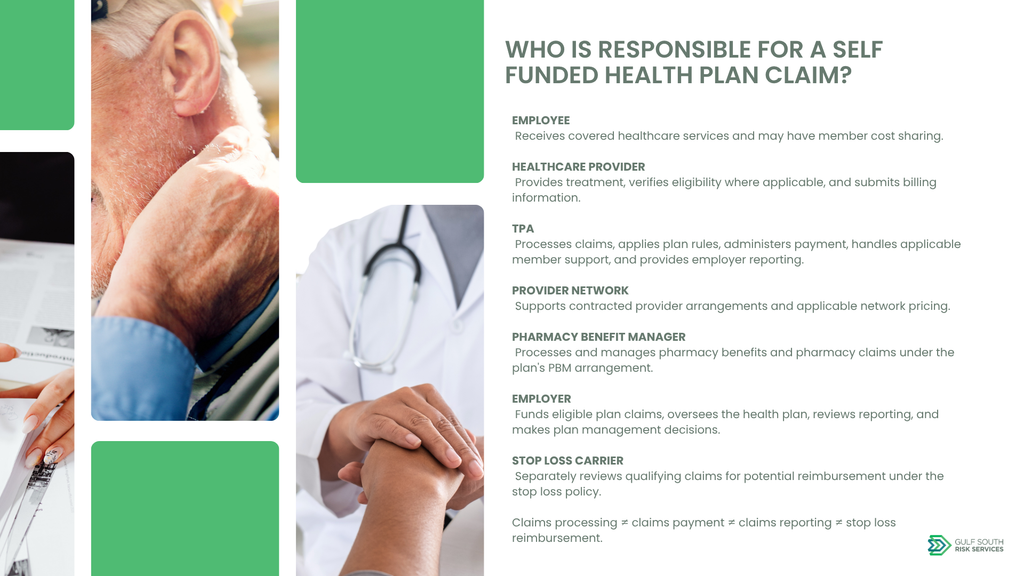
The self funded health plan claims process involves several parties, with each having a different responsibility.
| Task | Responsible Party |
| Medical treatment | Healthcare provider |
| Billing | Healthcare provider |
| Claims review | TPA |
| Claims payment administration | TPA |
| Funding | Employer |
| Stop loss review | Stop loss carrier |
| Employer reports | TPA |
| Plan oversight | Employer and broker |
The exact division of responsibilities can vary by plan and vendor arrangement. A pharmacy benefit manager may handle pharmacy claims, while a provider network manages contracted provider arrangements.
Common Misconceptions About Claims Processing
Several misconceptions can make self funded claims administration seem more complicated than it is.
“Employers approve claims.”
Generally false. Employers fund the health plan and oversee the plan, but individual claims are typically processed by the TPA or claims administrator under the plan’s established rules.
“TPAs insure the plan.”
False. A TPA provides administrative services. A self funded employer remains responsible for covered claims. A TPA does not automatically assume the employer’s claims liability.
“Stop loss pays providers.”
Generally false. The self funded plan pays eligible provider claims. Stop loss insurance may reimburse the employer for qualifying amounts under a separate policy.
“Employers can read employee medical files.”
False. Employers do not receive unrestricted access to employees’ private medical information. Reporting and data access must be handled according to applicable privacy requirements and the plan’s administrative arrangements.
Questions Employers Should Ask About Claims Administration
Before selecting or reviewing a TPA, employers should ask:
- How quickly are claims typically processed?
- How often will the employer receive claims reports?
- How are claim appeals handled?
- Who answers employee questions about claims?
- How are large claims identified and monitored?
- How are pharmacy claims managed?
- What claims data will be available for renewal and plan analysis?
- How are claims coordinated with the provider network and stop loss carrier?
These questions can help an employer understand the difference between simply having claims processed and having effective health plan claims administration.
Need Help Understanding Claims Administration?
A well managed claims process depends on coordination between the employer, third party administrator, provider networks, pharmacy benefit managers, and stop loss carriers. Gulf South Risk Services helps employers understand how these moving parts work together, what reports to review, and what questions to ask throughout the year.
Contact Gulf South Risk Services to discuss self funded health plan administration and claims reporting.
Frequently Asked Questions
Who processes claims in a self funded health plan?
A third party administrator or other claims administrator typically processes claims for a self funded health plan. The TPA reviews eligibility, coverage, coding, network arrangements, and other applicable requirements before determining how the claim should be handled.
Does the employer approve medical claims?
Usually, no. The employer funds the self funded plan and oversees the plan, but individual medical claims are generally processed by the TPA or claims administrator. Employers do not normally determine whether individual medical services should be approved.
What does a TPA do during claims processing?
A TPA manages much of the administrative claims process. This can include receiving claims, verifying eligibility, applying plan provisions, processing network discounts, calculating member responsibility, administering payment, handling certain appeals, and providing employer reporting.
What happens if a claim is denied?
A denied claim is not approved for payment under the applicable plan rules. The employee or provider may have appeal rights depending on the plan. The TPA typically communicates the determination and any applicable next steps according to the plan’s procedures.
When does stop loss insurance become involved?
Stop loss insurance may become involved when eligible claims reach the applicable specific or aggregate threshold under the stop loss policy. The underlying health plan continues to pay eligible claims, while the stop loss carrier separately reviews whether reimbursement is available under its contract.
What reports should employers review each month?
The most useful reports depend on the plan, but employers may review claims activity, large claimant information, pharmacy spending, utilisation, network use, cost trends, and other aggregated claims data. These reports can support budgeting, renewal planning, and cost management.