Prescription drug spending continues to be one of the fastest-growing components of healthcare expenses for many employers. If you’ve been asking what is a Pharmacy Benefit Manager, the short answer is this: a Pharmacy Benefit Manager (PBM) administers prescription drug benefits for an employer health plan by managing pharmacy networks, processing pharmacy claims, developing formularies, and coordinating prescription drug programs.
PBMs play an important role in many self-funded health plan arrangements, working alongside a Third-Party Administrator (TPA) to help employers administer prescription benefits while supporting employees’ access to medications. Rather than serving as insurance companies, PBMs focus specifically on pharmacy benefits administration and prescription drug management.
In this guide, we’ll explain how PBMs work, how they interact with TPAs, why employers and benefits brokers use them, and what organizations should consider when evaluating pharmacy benefit strategies.
Have questions about pharmacy benefit strategy? Contact Gulf South Risk Services to learn how independent health plan administration can support customized pharmacy benefit solutions for your organization.
What Is a Pharmacy Benefit Manager?
A Pharmacy Benefit Manager (PBM) is an organization that administers prescription drug benefits on behalf of employer-sponsored health plans, insurance programs, and government healthcare programs. PBMs help manage the pharmacy portion of an employer health plan by coordinating prescription coverage, maintaining pharmacy networks, processing pharmacy claims, and supporting medication management programs.
In simple terms, while a medical administrator manages healthcare claims related to physician visits, hospital care, and other medical services, a PBM focuses specifically on prescription medications.
PBMs commonly work with:
- Self-funded employers
- Fully insured health plans
- Municipalities
- School districts
- Healthcare organizations
- Benefits brokers
- Third-party administrators
Within many self-funded health plans, the PBM becomes one part of a broader administrative ecosystem. An independent TPA, such as Gulf South Risk Services, coordinates with the PBM, medical provider networks, stop-loss carriers, and other vendors to create a cohesive employee benefits program.
Unlike a traditional insurance carrier that may require employers to use proprietary pharmacy solutions, many independent TPAs offer flexibility by allowing employers and brokers to select the PBM that best aligns with their organization’s goals.
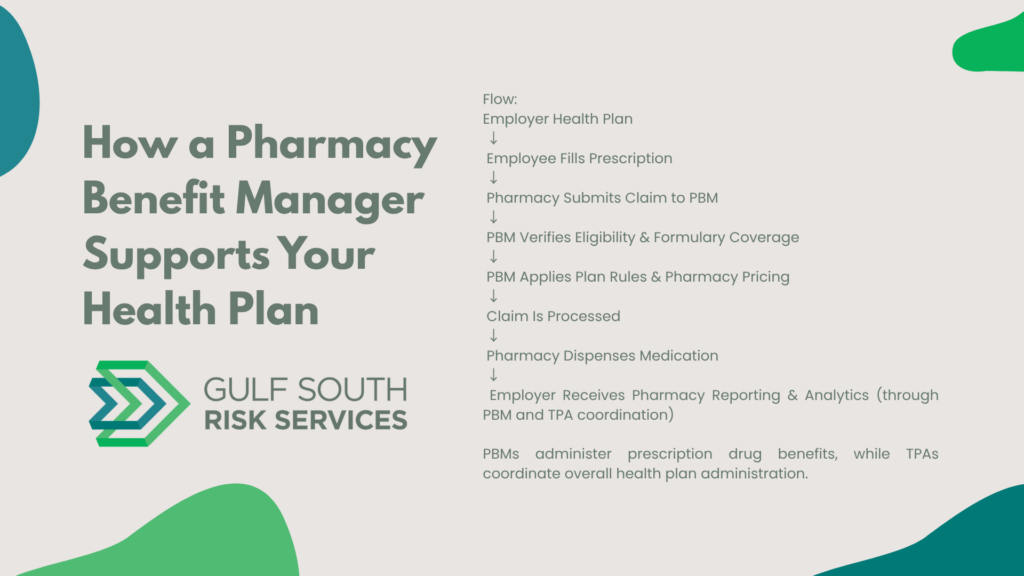
A PBM administers prescription drug benefits, while an independent TPA coordinates the broader health plan administration that brings multiple benefit partners together.
What Does a PBM Actually Do?
Many employers assume PBMs simply negotiate drug prices. In reality, modern PBMs manage a wide range of administrative and clinical functions that help keep prescription benefit programs operating efficiently.
Typical pharmacy benefits administration responsibilities include:
- Processing pharmacy claims
- Managing retail and mail-order pharmacy networks
- Developing and maintaining drug formularies
- Coordinating specialty pharmacy programs
- Supporting medication management initiatives
- Administering utilization management programs
- Managing prior authorization processes
- Supporting step therapy requirements where applicable
- Providing employer reporting and analytics
- Coordinating with health plan administrators and brokers
Pharmacy Claims Processing
Every time an employee fills a prescription, the PBM receives and adjudicates the pharmacy claim. The system verifies eligibility, applies plan rules, determines member cost sharing, and communicates payment information to the pharmacy.
This process allows employees to receive medications without manually submitting claims in most situations.
Pharmacy Network Management
PBMs establish and manage pharmacy networks that include retail pharmacies, mail-order providers, and specialty pharmacies. Depending on the employer’s plan design, employees may have access to a broad network of participating pharmacies.
Network design can influence convenience, member experience, and overall pharmacy program administration.
Formulary Management
A formulary is a list of prescription medications covered under the health plan. Formularies often group medications into different coverage tiers based on clinical guidance and plan design.
For example, a plan may encourage the use of generic medications when appropriate while still covering brand-name or specialty medications under different benefit structures.
Importantly, formularies vary by PBM and employer health plan. They are designed to support consistent prescription benefit administration rather than create a one-size-fits-all solution.
Specialty Pharmacy Administration
Specialty medications often require additional coordination because they may involve complex handling requirements, higher costs, or ongoing clinical monitoring.
PBMs frequently coordinate specialty pharmacy services that include:
- Medication fulfillment
- Clinical monitoring
- Patient education
- Care coordination
- Refill management
These services help employers administer increasingly complex prescription drug benefits while supporting members with chronic or specialized conditions.
Utilization Management
Many PBMs also administer utilization management programs that help ensure medications are used appropriately according to plan guidelines.
Examples include:
- Prior authorization
- Quantity limits
- Step therapy
- Clinical review programs
These processes are intended to support appropriate medication use while aligning with the employer’s benefit design.
PBMs do far more than negotiate prescription prices. They administer the day-to-day pharmacy benefit operations that support employees, pharmacies, employers, and healthcare providers.
How PBMs Work With Third-Party Administrators
A common misconception is that the PBM manages the entire health plan. In reality, PBMs and Third-Party Administrators (TPAs) perform different—but highly complementary—roles.
For many self-funded health plans, the TPA serves as the central administrator, coordinating multiple specialized vendors. The PBM focuses exclusively on prescription drug benefits, while the TPA oversees broader health plan administration, employee benefits administration, and claims administration.
A typical division of responsibilities may look like this:
| Third-Party Administrator (TPA) | Pharmacy Benefit Manager (PBM) |
| Medical claims administration | Pharmacy claims administration |
| Eligibility management | Prescription benefit management |
| Customer service | Pharmacy network administration |
| Employer reporting | Formulary management |
| Benefits administration | Specialty pharmacy coordination |
| Vendor integration | Medication management programs |
| Health plan administration | Pharmacy pricing administration |
This collaborative model allows employers to benefit from specialized expertise without sacrificing administrative consistency.
For example, Gulf South Risk Services uses a flexible administrative approach that allows employers and brokers to integrate the PBM that best fits their organization’s needs rather than being limited to a single proprietary pharmacy solution. This vendor flexibility supports customized plan design while maintaining centralized oversight through one experienced administrative partner.
Technology also plays an important role. Information from the PBM is often integrated with medical claims data, allowing employers to better understand healthcare utilization, prescription drug trends, and overall plan performance through consolidated reporting.
Strong coordination between the TPA and PBM can also improve the member experience. Employees benefit from clearer communication, streamlined support, and more consistent administration across both medical and pharmacy benefits.
The PBM manages prescription drug benefits, while the TPA coordinates the overall administration of the employer health plan, bringing multiple vendors together into a unified benefits program.
Why Employers Use Pharmacy Benefit Managers
Prescription drug expenses are a significant component of healthcare spending for many organizations. As costs continue to evolve, employers often look for partners that can help administer pharmacy benefits efficiently while supporting employees’ access to medications. A pharmacy benefit manager can play an important role in achieving those goals.
Rather than focusing solely on pricing, PBMs help employers manage the operational side of prescription drug benefits. Common responsibilities include coordinating pharmacy networks, administering formularies, processing pharmacy claims, and providing reporting that helps employers better understand utilization patterns.
Organizations may work with a PBM to support:
- Prescription drug cost management
- Pharmacy network access
- Clinical support programs
- Medication adherence initiatives
- Specialty pharmacy coordination
- Employer reporting and analytics
- Healthcare cost containment efforts
For employers with a self-funded health plan, pharmacy benefits are often one component of a broader benefits strategy. Working alongside an experienced Third-Party Administrator (TPA) allows pharmacy administration to integrate with medical claims, eligibility, and other aspects of health plan administration.
Benefits brokers also frequently help employers evaluate PBM options based on workforce needs, reporting capabilities, technology integration, and service expectations. Because every organization is different, the most appropriate PBM arrangement depends on plan objectives, employee demographics, and long-term benefits goals.
Employers use PBMs to administer prescription drug benefits, improve operational efficiency, and support informed decision-making—not simply to negotiate drug prices.
Understanding Formularies and Pharmacy Networks
Two of the most important concepts in pharmacy benefits administration are formularies and pharmacy networks. Understanding how these components work can help employers and employees better navigate prescription coverage.
What Is a Formulary?
A formulary is a list of medications covered under the health plan. PBMs develop and maintain formularies using clinical guidance, utilization data, and plan design objectives.
Most formularies organize medications into coverage tiers, such as:
- Generic medications
- Preferred brand-name medications
- Non-preferred brand medications
- Specialty medications
Different tiers may have different member cost-sharing requirements, depending on the employer’s benefit design.
A common misconception is that formularies never change. In reality, formularies are reviewed periodically and may be updated based on new medications, clinical evidence, or plan decisions.
What Is a Pharmacy Network?
A pharmacy network is the group of pharmacies that participate in the employer’s prescription benefit program. Networks may include:
- Retail pharmacies
- Independent pharmacies
- National pharmacy chains
- Mail-order pharmacies
- Specialty pharmacy providers
Employees generally have access to participating pharmacies within the network established for their plan.
For individuals taking specialty medications or long-term maintenance prescriptions, mail-order or specialty pharmacy services may also be available depending on plan design.
When coordinated effectively by the PBM and TPA, formularies and pharmacy networks help create a consistent prescription benefit experience while supporting access to covered medications.
Formularies determine which medications are covered, while pharmacy networks determine where employees can fill their prescriptions.
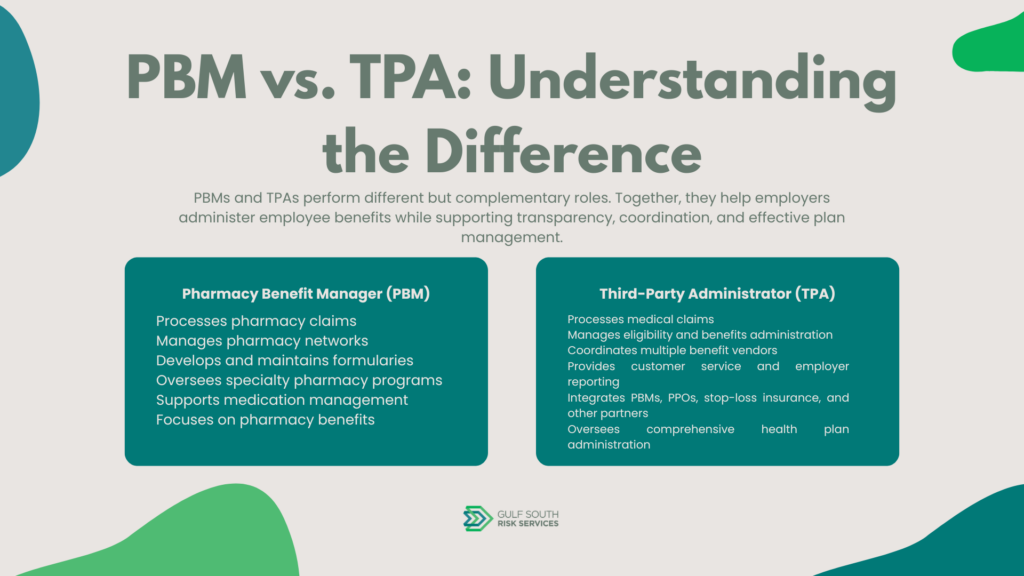
PBM vs. TPA: What’s the Difference?
Although PBMs and TPAs often work together, they perform distinct functions within an employer-sponsored health plan.
| Pharmacy Benefit Manager (PBM) | Third-Party Administrator (TPA) |
| Administers prescription drug benefits | Administers the overall health plan |
| Processes pharmacy claims | Processes medical claims |
| Manages pharmacy networks | Manages medical claims administration |
| Develops formularies | Oversees eligibility and benefits administration |
| Coordinates specialty pharmacy | Coordinates multiple benefit vendors |
| Supports medication management | Provides customer service and employer reporting |
| Focuses on prescription benefits | Integrates medical, pharmacy, and administrative services |
A PBM is not an insurance company, and a TPA is not a PBM. Instead, both organizations contribute specialized expertise within a broader employee benefits program.
For employers with self-funded health plans, the TPA often acts as the central coordinator. Gulf South Risk Services, for example, works with employers and brokers to integrate best-fit PBMs, PPO networks, stop-loss insurance providers, and other vendors through a flexible administrative model.
This approach differs from arrangements that require employers to use a single proprietary pharmacy solution. Independent administration gives organizations greater flexibility to design programs that align with their operational goals while maintaining centralized oversight.
Another common misconception is that PBMs replace TPAs. In reality, they complement one another. The PBM focuses on prescription drug benefits, while the TPA coordinates the overall administration of the health plan.
PBMs and TPAs are partners, not competitors. Each serves a different role in delivering effective employee benefits administration.
Questions Employers Should Ask About Their PBM
Selecting or evaluating a PBM involves more than comparing prescription pricing. Employers and benefits brokers should understand how pharmacy benefits fit into the overall health plan and what level of support the PBM provides.
Consider asking questions such as:
- What reporting and analytics are available?
- How transparent is pharmacy claims reporting?
- How is the pharmacy network structured?
- How are specialty drugs managed?
- What clinical support programs are available?
- How are prior authorization and utilization management administered?
- How does the PBM integrate with our Third-Party Administrator?
- What technology integrations are available?
- How is member support handled?
- How will brokers and employers receive ongoing performance updates?
These discussions can help employers better understand how pharmacy benefits align with their broader employee benefits strategy.
Asking thoughtful questions helps employers evaluate pharmacy benefit partners based on service, reporting, transparency, and long-term administrative support rather than focusing on a single factor alone.
How Independent TPAs Provide More PBM Flexibility
One of the advantages of working with an independent TPA is the ability to build an employee benefits program around the organization’s needs rather than a predetermined vendor ecosystem. Instead of requiring employers to use a proprietary pharmacy solution, an independent administrator can often coordinate with multiple Pharmacy Benefit Manager (PBM) partners.
This flexibility can benefit employers and benefits brokers in several ways:
- Greater choice in PBM selection
- Customized health plan administration
- Integration with existing vendors
- More adaptable plan design
- Centralized oversight through one administrative partner
For example, an employer may want to retain its current PBM while changing other aspects of its self-funded health plan. An independent Third-Party Administrator can often support that approach by coordinating eligibility, claims administration, reporting, customer service, and vendor communication across multiple partners.
Gulf South Risk Services follows this independent model through its flexible technology and vendor integration approach. Rather than locking employers into a single PBM, the company works with brokers and employer groups to integrate pharmacy partners that align with each organization’s objectives. This collaborative philosophy helps preserve broker relationships while supporting customized plan administration.
Vendor flexibility also becomes increasingly valuable as healthcare needs evolve. Employers may periodically evaluate new PBMs, expand specialty pharmacy programs, or introduce additional healthcare cost containment initiatives. An experienced TPA can help coordinate these changes while maintaining administrative continuity.
Independent TPAs provide employers with greater flexibility to choose PBM partners that fit their plan goals while keeping administration coordinated and member-focused.
Choosing the Right Pharmacy Benefit Strategy
There is no universal pharmacy benefit strategy that fits every employer. The most appropriate approach depends on organizational priorities, workforce demographics, healthcare utilization, and long-term employee benefits objectives.
When evaluating pharmacy benefit programs, employers and brokers should consider:
Workforce Needs
A younger workforce may have different prescription utilization patterns than an organization with a larger population managing chronic conditions or specialty medications.
Claims History
Reviewing pharmacy claims alongside medical claims can provide valuable insights into utilization trends, prescription categories, and opportunities for ongoing plan evaluation.
Business Goals
Organizations may prioritize:
- Member experience
- Administrative simplicity
- Reporting capabilities
- Vendor flexibility
- Long-term sustainability
- Integrated benefits administration
Understanding these priorities can help guide PBM selection and overall plan design.
Broker Collaboration
Benefits brokers play an important role in helping employers evaluate pharmacy benefit strategies. They can compare vendors, review service models, and help organizations understand how different PBMs fit within broader employee benefits programs.
Administrative Expertise
Coordinating a PBM with medical administration, eligibility, customer service, reporting, and other vendors requires experience. Working with an independent TPA that supports flexible vendor integration can simplify administration while giving employers greater visibility into overall plan performance.
It’s also important to remember that pharmacy benefit strategies should evolve over time. As prescription drug trends, workforce needs, and healthcare priorities change, employers may periodically reassess their PBM relationships and broader benefits strategy.
The best pharmacy benefit strategy aligns with an organization’s workforce, goals, administrative preferences, and long-term employee benefits objectives.
Final Thoughts
If you’ve been asking what is a Pharmacy Benefit Manager, the answer extends far beyond negotiating prescription prices. A PBM administers prescription drug benefits through pharmacy networks, formulary management, pharmacy claims processing, specialty pharmacy coordination, and medication management programs.
For employers with a self-funded health plan, PBMs often work alongside a Third-Party Administrator to deliver integrated employee benefits administration. While the PBM focuses on prescription coverage, the TPA coordinates the broader health plan, bringing together medical claims administration, reporting, customer service, vendor integration, and member support.
Every employer’s needs are different. Evaluating pharmacy benefit options requires balancing employee access, administrative efficiency, healthcare transparency, and long-term plan objectives rather than focusing on any single solution.
Contact Gulf South Risk Services to learn more about Health Plan Administration, pharmacy benefit coordination, and customized employee benefits solutions that support your organization’s goals.
Frequently Asked Questions
What is a Pharmacy Benefit Manager?
A Pharmacy Benefit Manager (PBM) administers prescription drug benefits for employer-sponsored health plans. PBMs manage pharmacy networks, develop formularies, process pharmacy claims, coordinate specialty pharmacy services, and support employers in administering prescription coverage.
What does a PBM do?
PBMs administer prescription drug programs by processing pharmacy claims, maintaining pharmacy networks, managing formularies, supporting utilization management, coordinating specialty pharmacy services, and providing reporting that helps employers monitor prescription benefit performance.
How does a PBM work with a TPA?
A PBM manages prescription drug benefits, while a Third-Party Administrator (TPA) manages broader health plan operations such as medical claims administration, eligibility, customer service, and reporting. Together, they help administer self-funded health plans more efficiently.
Why do employers use PBMs?
Employers use PBMs to administer prescription drug benefits, improve access to pharmacy networks, support medication management, coordinate specialty pharmacy services, and gain reporting that helps inform long-term employee benefits planning.
What is a formulary?
A formulary is the list of prescription medications covered under a health plan. Medications are typically organized into coverage tiers based on plan design and clinical considerations, helping determine member cost sharing and prescription coverage.
Can employers choose their PBM?
Often, yes. Many organizations working with an independent TPA can evaluate and select the PBM that best fits their goals, depending on their plan structure and administrative model. Vendor flexibility varies by employer and plan design.
What questions should brokers ask about PBMs?
Benefits brokers should ask about reporting capabilities, PBM transparency, pharmacy network access, specialty pharmacy programs, technology integration, customer service, formulary management, and how the PBM coordinates with the TPA to support the overall employer health plan.