Choosing the right third-party administrator requires more than comparing administrative fees or reviewing a list of services. Brokers need to understand whether a TPA can support their client relationships, provide reliable service, and adapt to different employer needs.
The questions brokers should ask a TPA should focus on claims administration, technology, vendor flexibility, member support, reporting, and long-term partnership. The right TPA can help brokers deliver a stronger experience for employers by providing flexible administration and responsive support.
For benefits brokers working with self-funded health plans, the TPA becomes an important part of the overall strategy. Their service model, communication style, and operational capabilities can directly affect client satisfaction and retention.
This guide explains the key areas brokers should evaluate before recommending a third-party administrator and how to identify a partner that supports both the broker and employer.
Why Brokers Need to Evaluate TPAs Differently Than Employers
Employers and brokers may evaluate a TPA from different perspectives. Employers often focus on healthcare costs, employee experience, administration quality, and operational efficiency. Brokers must consider those factors while also evaluating how the TPA affects their client relationship.
A TPA becomes part of the broker’s service promise. When claims questions, implementation issues, or member concerns occur, the TPA’s responsiveness can influence how the employer views the entire benefits strategy.
A strong TPA should support the broker rather than compete with them. This includes clear communication, defined escalation processes, transparent reporting, and respect for the broker’s role as the employer’s trusted advisor.
For brokers evaluating a TPA for brokers, important considerations include:
- How does the TPA communicate with brokers and employers?
- Who manages service issues when they arise?
- Does the TPA provide flexibility in plan design?
- Will the TPA support the broker’s relationship with the employer?
A broker-friendly TPA understands that successful administration depends on collaboration between the employer, broker, and administrative partner.
The best TPA relationship strengthens the broker-client connection instead of creating additional administrative challenges.
1. Are You Independent or Carrier-Owned?
One of the first questions brokers should ask a TPA is whether the organization operates as an independent TPA or is connected to a larger insurance carrier structure.
An independent TPA may provide greater flexibility because it can often work with a wider range of vendors, technologies, and plan strategies. This can be important for employers who want customized solutions instead of a fixed administrative model.
Carrier-owned TPAs may offer different advantages depending on the employer’s needs. The important consideration is whether the TPA’s structure aligns with the plan goals and the broker’s approach.
Brokers should ask:
- Are you an independent TPA?
- Can employers choose their preferred vendors?
- Do you support different plan designs?
- Are there required technology platforms or vendor relationships?
For self-funded health plans, flexibility can be an important factor. Employers may need different combinations of services, including a pharmacy benefit manager, PPO network, stop-loss coordination, care management, or specialized reporting.
Gulf South Risk Services operates as an independent TPA, allowing employers and brokers to evaluate administration solutions based on their specific needs. A flexible approach allows brokers to help clients build a plan structure that fits their objectives.
Independence can provide more options when employers need customized administration and vendor flexibility.
2. How Do You Support Broker Relationships?
A key question brokers should ask a TPA is how the organization manages broker relationships after implementation.
The TPA should understand that the broker remains a central part of the employer relationship. A strong administrative partner provides support while respecting the broker’s role.
Brokers should ask:
- How do you communicate with brokers during ongoing administration?
- Who receives service updates and reporting?
- How are escalated issues handled?
- How do you support broker-client conversations?
A broker-friendly TPA creates clear communication channels between all parties. This helps prevent confusion when employers have questions about claims, eligibility, benefits administration, or plan performance.
The best partnerships are built on transparency. Brokers should feel confident that the TPA will provide accurate information, respond quickly, and work collaboratively when challenges arise.
A TPA should not replace the broker relationship. Instead, it should help the broker deliver a better experience.
A strong TPA protects the broker-client relationship through communication, support, and collaboration.
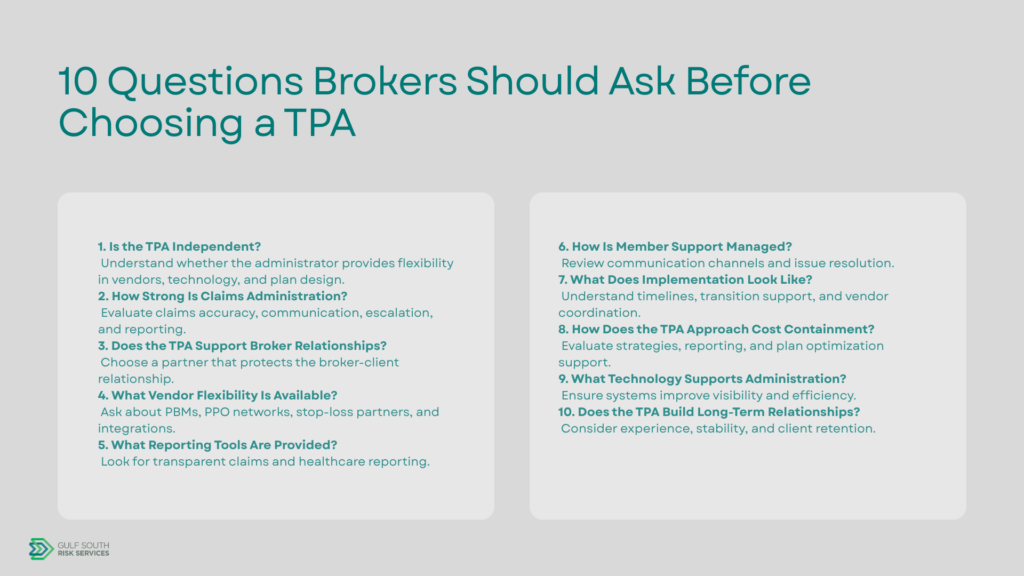
3. What Is Your Claims Administration Process?
Claims administration is one of the most important areas brokers should evaluate when choosing a TPA. While many organizations can process claims, the quality of claims management can vary significantly.
Brokers should ask detailed questions about:
- Claims processing procedures
- Claim review standards
- Adjuster experience
- Quality control processes
- Escalation procedures
- Reporting capabilities
A reliable claims administration process should include accurate documentation, timely communication, and clear ownership when issues occur.
For employers with complex benefit structures or workers’ compensation programs, experienced claims professionals can make a significant difference. Workers’ compensation administration requires knowledge of workplace injuries, medical coordination, return-to-work processes, and risk management practices.
Health plan claims also require careful administration. Medical claims, eligibility questions, provider issues, and member concerns all require structured processes and responsive support.
Brokers should understand how a TPA manages claims from initial submission through resolution. Questions about turnaround times, communication processes, and reporting tools can provide insight into the TPA’s operational approach.
Claims quality also affects the employer’s overall view of their benefits program. Delays, unclear communication, or unresolved issues can create frustration for both employers and employees.
Strong claims administration supports better service experiences and helps brokers maintain client confidence.
4. What Level of Customer Service Can Brokers and Employers Expect?
Customer service is one of the most important factors brokers should evaluate when selecting a third-party administrator. A TPA may have strong technology and processes, but the day-to-day service experience often determines whether the relationship succeeds.
Brokers should ask:
- Who will be our primary point of contact?
- How quickly are employer and member questions answered?
- How are urgent issues escalated?
- What support is available for brokers after implementation?
Member support, employer support, and broker support should all be considered. Employees may need help understanding benefits, claims questions, eligibility issues, or provider communication. Employers need reliable answers about plan administration and reporting. Brokers need confidence that service concerns will be handled professionally.
A service-focused TPA understands that administration is not only about systems and processes. It is also about communication, accessibility, and problem resolution.
Gulf South Risk Services focuses on building long-term relationships through responsive service and direct communication. For brokers, this approach helps create a smoother experience for employers and their employees.
Service quality should be evaluated alongside technology, pricing, and administration capabilities.
5. Can You Work With Our Preferred PBMs, PPO Networks, and Vendors?
Vendor flexibility is another important consideration when choosing a TPA. Employers and brokers often need the ability to select solutions that align with their plan strategy rather than being limited to a single vendor ecosystem.
Brokers should ask:
- Can employers choose their pharmacy benefit manager (PBM)?
- Can you support different PPO network options?
- How do you coordinate with stop-loss partners?
- What vendor integrations are available?
- Can you work with existing benefit partners?
A flexible TPA should be able to coordinate multiple components of an employer health plan, including pharmacy benefits, provider networks, technology platforms, and reporting tools.
For example, a self-funded health plan may use one vendor for pharmacy benefits, another for care management, and another for stop-loss insurance. Effective vendor integration helps these different services work together while maintaining a consistent member experience.
Some TPAs use proprietary systems or require specific vendor relationships. That structure may work for some employers, but brokers should understand any limitations before recommending a solution.
Gulf South Risk Services takes a flexible approach by working with different vendors and technology partners. This allows brokers and employers to evaluate options based on plan goals, member needs, and administrative requirements.
Vendor flexibility allows brokers to support more customized employer solutions.
6. How Do You Approach Cost Containment?
Cost containment is a major consideration for many employers evaluating self-funded health plans. However, brokers should look beyond simple cost comparisons and understand how a TPA approaches healthcare cost management.
Important questions include:
- How do you use claims data to identify trends?
- What reporting is available to employers and brokers?
- Do you support utilization management programs?
- How do you coordinate case management?
- Can you administer strategies such as reference-based pricing?
Effective cost containment involves understanding healthcare spending patterns and using available information to support informed decisions.
A TPA may support healthcare cost containment through several approaches, including:
- Claims analysis and reporting
- Utilization management
- Case management programs
- Care coordination
- Provider network evaluation
- Pharmacy benefit review
- Plan design support
Cost containment strategies should be evaluated based on the employer’s goals, workforce needs, and overall benefits strategy. No single approach is appropriate for every organization.
Experienced TPAs can help employers understand available options while providing the administration needed to support these programs.
Gulf South Risk Services helps employers evaluate plan administration strategies that may support better visibility into healthcare spending and claims activity.
Effective cost containment depends on data, administration, and a plan strategy that fits the employer.
7. What Technology and Reporting Will We Have Access To?
Technology should make administration easier, not create additional complexity. Brokers should evaluate how a TPA uses technology to improve transparency, communication, and reporting.
Questions to ask include:
- What reporting tools are available?
- Can employers access claims data?
- How are eligibility updates managed?
- Are member portals available?
- How do systems integrate with other vendors?
Healthcare reporting can help employers and brokers understand plan performance, claims activity, utilization patterns, and areas requiring attention.
Technology can also support vendor integration between services such as:
- Pharmacy benefit managers
- PPO networks
- Claims platforms
- Member portals
- Care management systems
However, technology should not replace service. A strong platform is valuable when supported by knowledgeable professionals who can interpret information and help resolve issues.
Brokers should evaluate whether the TPA’s technology supports their client’s needs without creating unnecessary barriers.
The best technology improves visibility and efficiency while maintaining human support.
8. What Does Implementation Look Like?
Implementation is an important area for brokers to evaluate because transitions can affect employers, employees, and vendors.
Before recommending a TPA, brokers should ask:
- What does the implementation timeline look like?
- Who manages the transition process?
- How are eligibility files transferred?
- How are vendors coordinated?
- How are employees informed about changes?
A structured implementation process should include planning, communication, testing, and ongoing support.
Changing administrators does not have to create unnecessary disruption when the process is carefully managed. Experienced TPAs should have clear procedures for moving data, coordinating vendors, and supporting employers during the transition.
Brokers should understand who owns each part of the implementation process and how updates will be communicated.
Gulf South Risk Services emphasizes stability and organized transitions to help employers move forward with confidence while maintaining continuity for members.
A clear implementation plan helps reduce disruption and supports a smoother administrative transition.
9. How Do You Support Members and Providers?
Member and provider support directly affects employer satisfaction and broker relationships. When employees have questions about benefits, claims, or eligibility, they need access to accurate information and helpful assistance.
Brokers should ask:
- How do members contact support?
- Is there a member portal?
- How are provider questions handled?
- Who manages claims questions?
- Is human support available?
A strong TPA should support the complete member experience, including:
- Benefit questions
- Claims assistance
- Eligibility support
- Provider communication
- Access to plan information
Provider support is also important. Clear communication with healthcare providers can help address questions related to claims processing, reimbursement, and plan requirements.
The goal is to create an administration experience where employers, employees, and providers can access the information they need.
Member support is a critical part of successful benefits administration.
10. What Is Your Client Retention and Relationship History?
A TPA’s history with employers can provide insight into its approach to service, communication, and long-term relationships.
Brokers should ask:
- How long have your clients typically worked with you?
- What industries do you support?
- How stable is your leadership team?
- How do you maintain client relationships?
Long-term relationships can demonstrate operational consistency, but brokers should also evaluate the quality of communication and service provided throughout the relationship.
An experienced TPA should be able to explain how it supports employers over time, adapts to changing needs, and maintains strong partnerships.
Gulf South Risk Services has built relationships by focusing on responsive administration, flexible solutions, and personalized service. For brokers, long-term stability can be an important factor when choosing an administrative partner.
Experience and relationship history can help brokers evaluate whether a TPA is built for long-term partnership.
Red Flags Brokers Should Watch For When Evaluating a TPA
When evaluating TPAs, brokers should look beyond advertised features and ask detailed questions about operations, service, and flexibility.
Potential warning signs include:
- Limited transparency around claims processes
- Slow or unclear communication
- Restricted vendor choices without explanation
- Limited reporting capabilities
- No clear implementation process
- Frequent technology changes
- Weak member support
- Unclear broker relationship policies
The lowest administrative fee does not always represent the best long-term value. A TPA that lacks service support, reporting, or flexibility may create challenges that affect the broker-client relationship.
Similarly, technology alone should not determine the decision. A strong system is valuable, but knowledgeable people and responsive service remain essential.
Brokers should evaluate the complete relationship, not just the administrative cost.
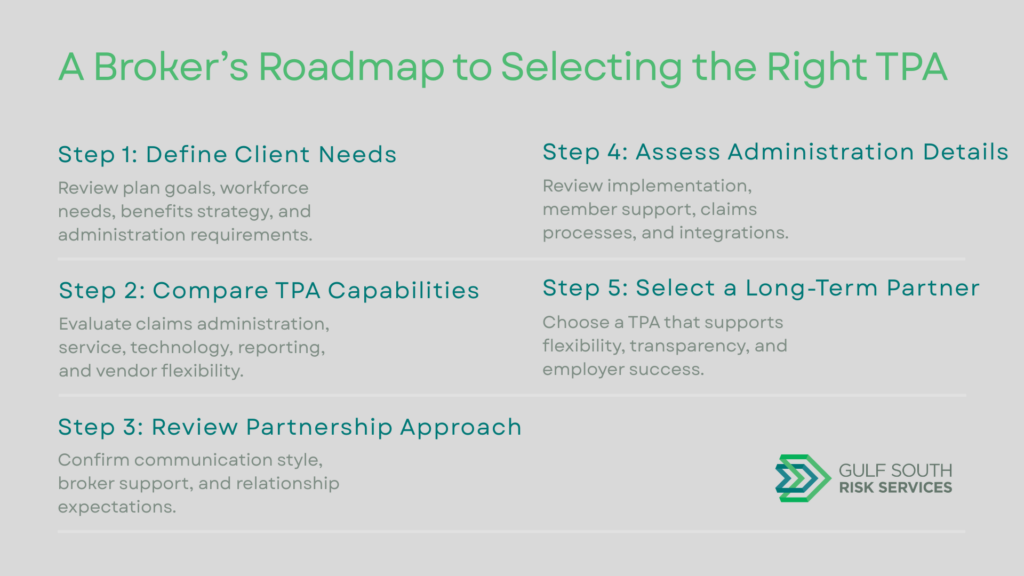
Broker Evaluation Checklist for Choosing a TPA
Use this checklist when comparing third-party administrators:
Independence and Flexibility
☐ Is the TPA independent?
☐ Does the TPA support multiple vendors?
☐ Can employers choose their preferred PBM and PPO network?
☐ Does the TPA allow customized plan strategies?
Claims Administration
☐ Who manages claims?
☐ What quality controls are in place?
☐ How are escalations handled?
☐ What claims reporting is available?
Service and Support
☐ Is there dedicated broker support?
☐ How are member issues resolved?
☐ What communication process is used?
☐ Are employers supported after implementation?
Technology and Reporting
☐ What systems are available?
☐ Can employers access healthcare analytics?
☐ How does vendor integration work?
☐ What reporting tools are provided?
Cost Containment Support
☐ Does the TPA support utilization management?
☐ Are care management and case management programs available?
☐ How are claims trends reviewed?
☐ Can the TPA support different plan designs?
Long-Term Partnership
☐ Does the TPA have strong client relationships?
☐ Does the organization understand broker partnerships?
☐ Is the service model aligned with employer goals?
A thorough evaluation process helps brokers select a TPA that supports employers, members, and long-term relationships.
Broker Takeaways
A strong TPA should protect the broker-client relationship.
- Independence matters when employers need flexibility.
- Claims service is one of the biggest drivers of client satisfaction.
- Vendor flexibility can support better plan customization.
- Technology should simplify administration, not create more friction.
- The lowest-cost TPA may not deliver the strongest long-term value.
Final Thoughts: The Right TPA Should Strengthen the Broker Relationship
Choosing a TPA is an important decision that affects employers, employees, and brokers. The right administrative partner should provide reliable claims administration, flexible vendor options, strong communication, and service that supports the overall benefits strategy.
The questions brokers should ask a TPA should focus on more than pricing. They should evaluate independence, technology, reporting, member support, cost containment, and relationship alignment.
Gulf South Risk Services works with brokers and employers to provide flexible health plan administration, claims support, and customized solutions. Contact Gulf South to discuss broker partnership opportunities and administration needs.
FAQs
What questions should brokers ask a TPA?
Brokers should ask about independence, claims administration, service response times, vendor flexibility, PBM and PPO options, cost containment, implementation, reporting, member support, and how the TPA protects broker-client relationships.
Why does TPA independence matter to brokers?
Independence can provide greater flexibility in plan design, vendor selection, PBM relationships, PPO networks, and administration strategies. It may help brokers build solutions that better align with employer goals.
What makes a TPA broker-friendly?
A broker-friendly TPA supports the broker’s relationship with the employer, communicates clearly, provides responsive service, and works collaboratively rather than competing for the client relationship.
Should brokers ask about PBM and PPO flexibility?
Yes. PBM and PPO flexibility can affect pharmacy benefits, provider access, healthcare costs, and member experience. Brokers should understand whether a TPA can integrate preferred vendors.
How important is claims administration when choosing a TPA?
Claims administration is one of the most important evaluation areas. Claims accuracy, communication, escalation processes, and experienced claims professionals can influence employer and employee satisfaction.
What are red flags when evaluating a TPA?
Red flags include poor communication, limited reporting, unclear implementation plans, rigid vendor requirements, frequent system changes, weak member support, and unclear broker relationship policies.
How can brokers compare TPAs fairly?
Brokers can compare TPAs using a structured checklist covering claims experience, customer service, technology, reporting, implementation, vendor flexibility, cost containment, member support, and long-term relationship history.