A self funded health plan and a fully insured health plan are not automatically better or worse than each other. The right choice depends on how an employer wants to manage claims risk, costs, administration, and plan control.
When comparing a self funded vs fully insured health plan, employers should understand who pays claims, who assumes financial responsibility, what claims data is available, and how the plan is administered. Gulf South Risk Services helps employers and brokers evaluate funding structures, claims administration needs, and health plan options based on organizational goals.
What Is the Difference Between a Self Funded and Fully Insured Health Plan?
The main difference is who assumes responsibility for employee healthcare claims.
A fully insured health plan is purchased by an employer from an insurance carrier. The employer pays a premium based on the policy terms, and the insurance carrier assumes responsibility for covered claims.
A self funded health plan is funded directly by the employer. The employer pays covered claims as they occur and may hire a third party administrator to handle claims processing, member services, reporting, and other administrative functions. Many self funded employers also purchase stop loss insurance to help manage larger claim exposures.
A self funded health insurance arrangement does not mean the employer handles every task internally. Administration is often shared between the employer, TPA, broker, pharmacy benefit manager, network partners, and other vendors.
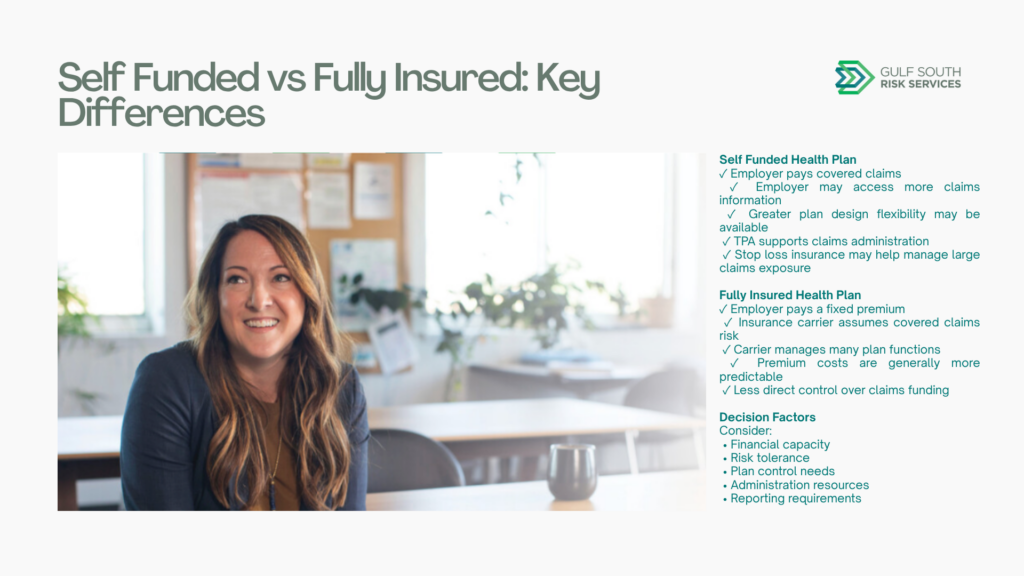
Self Funded vs Fully Insured Health Plan Comparison
The following table highlights key differences between the two employer health plan funding models.
| Factor | Self Funded Plan | Fully Insured Plan |
| Claims risk | Primarily retained by employer | Transferred to insurance carrier |
| Main payments | Claims, administration, stop loss, and other expenses | Insurance premium |
| Monthly predictability | Can vary based on claims | Generally more predictable during contract period |
| Plan control | Often greater | Generally more carrier controlled |
| Claims information | May provide greater access | May be more limited or summarized |
| Administration | Employer works with TPA and vendors | Carrier manages many functions |
| Regulation | Different regulatory structure may apply | Insurance policy regulated by state insurance rules |
The Centers for Medicare & Medicaid Services (CMS) distinguishes insured and self funded plans based on whether coverage is purchased from an insurer or paid directly by the employer plan.
How Do Costs Differ Between Self Funded and Fully Insured Plans?
Cost structures differ between the two models, but neither option guarantees lower expenses.
A fully insured plan typically includes:
- Fixed insurance premiums
- Employee contributions
- Carrier pricing assumptions
- Renewal adjustments based on plan experience
A self funded plan may include:
- Medical and pharmacy claims
- TPA fees
- Provider network fees
- Stop loss premiums
- Pharmacy administration costs
- Compliance and vendor expenses
A self funded plan may provide more visibility into actual healthcare spending through health plan claims data, while a fully insured plan offers greater short term premium predictability.
The lower initial estimate does not prove that one funding model will cost less over the entire plan year. Employers should compare total costs, administration requirements, and risk tolerance.
Which Option Provides More Control and Claims Visibility?
A self funded plan may provide employers with greater access to plan information and more flexibility in plan design.
Employers may be able to review:
- Plan level claims trends
- Healthcare utilization patterns
- Pharmacy spending
- Cost containment opportunities
- Vendor performance
Fully insured employers typically rely more on the insurance carrier’s plan options, reporting structure, pricing, and administration processes.
Access to information depends on contracts, privacy requirements, reporting arrangements, and vendor systems. Employers do not receive unrestricted access to individual employee medical information.
Gulf South Risk Services can help employers identify available reports and determine which questions to ask when reviewing plan performance.
How Does Financial Risk Compare?
Financial risk is one of the biggest differences between funding models.
With a fully insured health plan, the insurance carrier assumes covered claims risk under the policy. The employer pays the agreed premium regardless of whether claims are higher or lower than expected during the contract period.
With a self funded plan, the employer retains responsibility for covered claims. A stop loss carrier may reimburse qualifying claims above specific thresholds, but stop loss insurance does not remove all financial responsibility.
Specific and aggregate stop loss coverage address different types of claim exposure, and contract terms, exclusions, and attachment points should be reviewed carefully.
Employers can learn more about risk protection in Stop Loss Insurance Explained: How It Protects Self Funded Employers.
What Administrative Responsibilities Should Employers Consider?
Administration differs between the two models.
A fully insured plan may consolidate:
- Claims processing
- Provider network administration
- Member services
- Plan reporting
- Policy administration
A self funded plan may involve:
- Employer or plan sponsor oversight
- Third party administrator services
- Broker support
- Stop loss coordination
- Pharmacy benefit manager support
- Provider network management
Self funding does not mean an employer must administer every function internally. A TPA can provide important support with claims administration and benefits administration.
Self insured plans may also have federal reporting responsibilities that employers should review with qualified benefits, legal, or tax professionals.
Which Health Plan Is Better for Your Organization?
The better option depends on the employer’s goals, financial position, workforce characteristics, and risk tolerance.
A self funded plan may be worth evaluating when an employer:
- Wants greater plan control
- Values access to claims information
- Can manage variable claims costs
- Wants customized plan strategies
- Has access to experienced administrative partners
A fully insured plan may be worth evaluating when an employer:
- Prioritizes predictable premium payments
- Prefers the carrier to assume claims risk
- Wants a more consolidated arrangement
- Has limited internal administration resources
The decision should be based on financial modelling, plan objectives, workforce needs, vendor terms, and risk tolerance.
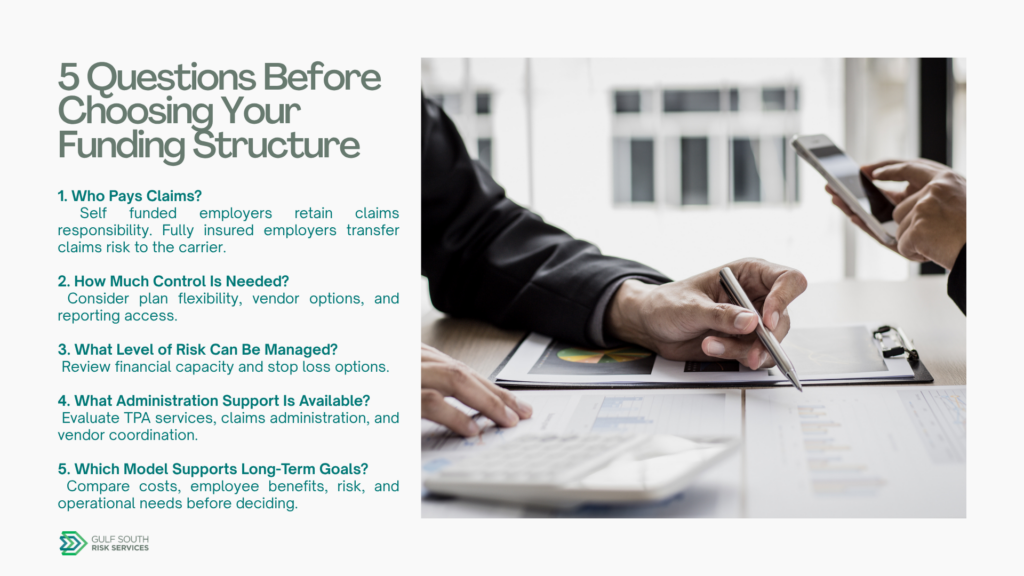
Questions to Ask Before Choosing a Funding Model
Before selecting a health plan structure, employers should ask:
- What is included in the total projected cost?
- Who assumes responsibility for covered claims?
- How much monthly cost variation can the organization manage?
- What claims and pharmacy reports will be available?
- Which administrative duties remain with the employer?
- What happens if claims are higher than projected?
Gulf South Risk Services can help employers and brokers compare administration requirements, reporting needs, claims processes, and plan responsibilities before making a funding decision.
Final Thoughts
A self funded health plan vs fully insured health plan decision requires careful evaluation of risk, cost structure, administration, and employee needs. A self funded arrangement may offer greater control and visibility, while a fully insured plan may provide more predictable premiums.
There is no single funding model that fits every employer. Gulf South Risk Services helps organizations evaluate plan administration, claims management, and funding considerations.
Compare Your Health Plan Options With Gulf South Risk Services
Choosing a funding model requires a clear understanding of claims risk, administration, reporting, and plan costs. Contact Gulf South Risk Services to discuss your organization’s needs and learn what questions to consider when comparing self funded and fully insured health plans.
FAQs
Is a self funded plan the same as a fully insured plan?
No. In a self funded plan, the employer is directly responsible for covered claims. In a fully insured plan, the employer purchases coverage from an insurance carrier that assumes covered claims risk under the policy.
Is self funded health insurance always less expensive?
No. Costs depend on claims experience, administration fees, stop loss coverage, pharmacy spending, plan design, and other factors. Self funding may provide greater control but does not guarantee lower costs.
Do employers process claims in a self funded plan?
Usually not. Many self funded employers hire a third party administrator to process claims, manage member services, and provide administrative support.
Can small employers use self funded plans?
Employer size alone does not determine suitability. Financial capacity, workforce stability, stop loss terms, administrative support, and plan goals should all be considered.