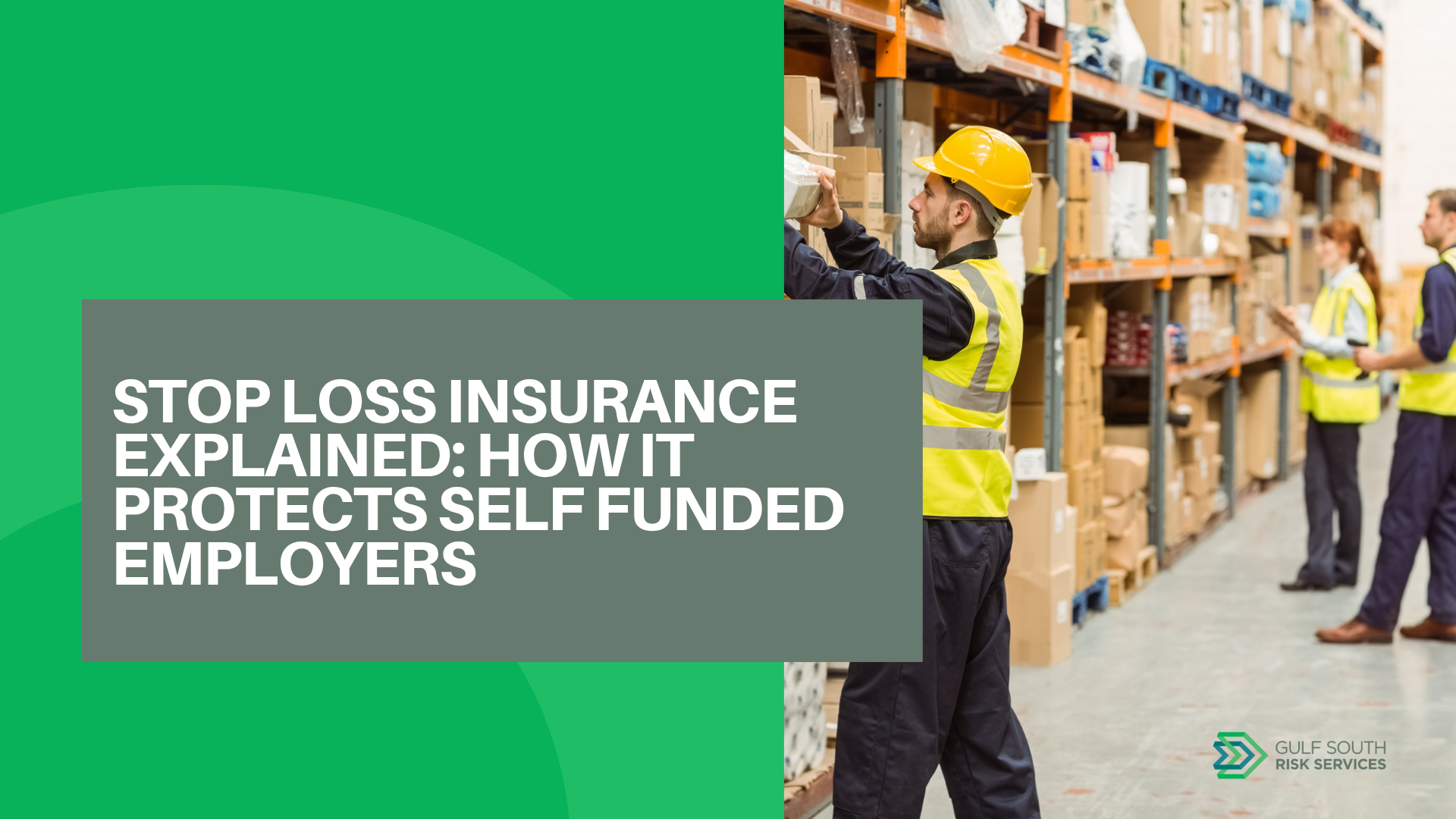
Stop loss insurance for self funded employers is designed to limit exposure to qualifying claims above defined policy thresholds. It does not replace the employer’s health plan or remove the employer’s responsibility to pay covered claims. Instead, it provides reimbursement when eligible claims meet the terms of a separate stop loss policy. The level of protection depends on specific and aggregate coverage, attachment points, contract periods, exclusions, and reimbursement rules. Gulf South Risk Services helps employers and brokers understand how stop loss fits with self funded health plan administration and claims processes.
What Is Stop Loss Insurance?
Stop loss insurance is a policy purchased by a self funded employer or plan sponsor to protect against qualifying claims above specified thresholds. It is separate from the self funded health plan and does not turn the plan into a fully insured arrangement.
The employer remains responsible for eligible plan claims. A third party administrator or claims administrator may process those claims and coordinate documentation for stop loss reimbursement. The stop loss carrier then reviews whether submitted amounts satisfy the separate policy terms.
A useful distinction is simple: health insurance provides benefits to covered members, while stop loss insurance protects the employer’s financial position under a separate contract. The U.S. Department of Labor describes stop loss as protection that may help self insured plans manage unexpectedly large medical claims.
How Does Stop Loss Insurance Work?
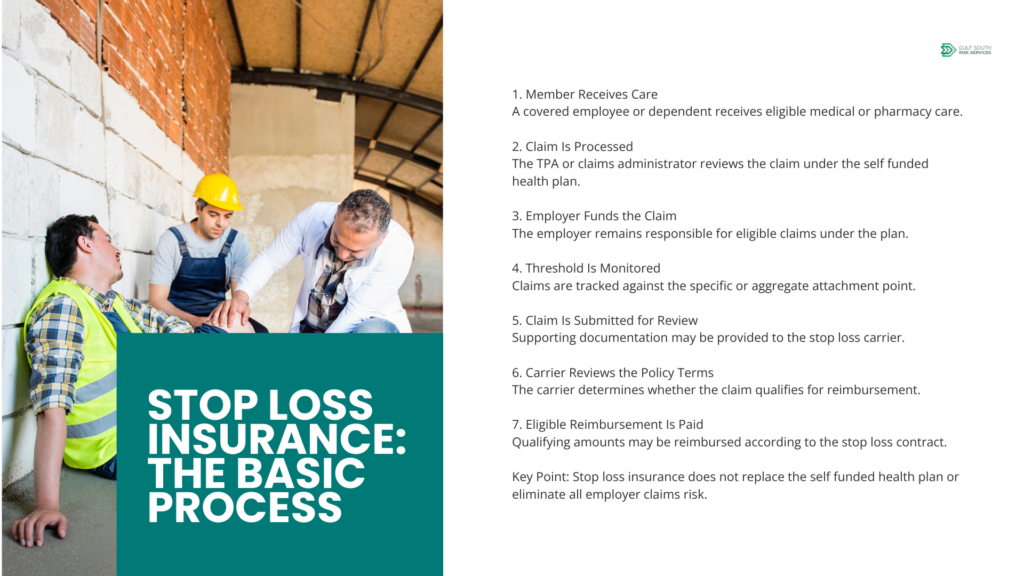
The basic claims and reimbursement process typically follows these steps:
- A covered employee or dependent receives eligible care.
- The provider submits the claim to the health plan.
- The TPA or claims administrator reviews the claim under the plan document.
- The employer funds the eligible claim according to the plan’s payment arrangement.
- The TPA tracks claims against the applicable stop loss threshold.
- Supporting documentation is submitted to the stop loss carrier.
- The carrier reviews whether the claim meets the policy terms.
- The carrier reimburses the employer for eligible amounts if the claim qualifies.
The exact process varies by contract and vendor arrangement. Reimbursement is not necessarily automatic when a claim exceeds a threshold.
Gulf South Risk Services can help employers understand how claims administration and stop loss coordination fit within a self funded health plan.
What Is Specific Stop Loss Insurance?
Specific stop loss insurance applies when eligible claims associated with one covered person exceed a defined threshold during the applicable contract period. That threshold is commonly called the specific attachment point or specific deductible.
The employer is generally responsible for eligible claims up to the threshold. Qualifying amounts above it may become eligible for stop loss reimbursement, subject to the policy’s exclusions, limitations, documentation requirements, and other terms.
Assume an employer has a $100,000 specific attachment point. If one covered person generates $250,000 in eligible claims during the applicable contract period, the employer may seek reimbursement for qualifying amounts above $100,000. The policy does not necessarily provide reimbursement for the full $150,000 difference.
Medical claims and pharmacy claims may also be treated differently depending on the policy.
What Is Aggregate Stop Loss Insurance?
Aggregate stop loss insurance provides protection based on total eligible claims across the plan rather than claims associated with one individual. The stop loss carrier establishes an aggregate attachment point, which sets the threshold for potential reimbursement.
The calculation may consider enrollment, expected claims, monthly factors, or other policy provisions. If total eligible claims exceed the aggregate threshold, the excess may qualify for reimbursement under the contract.
Illustrative example: If a plan has a $1.5 million aggregate attachment point and eligible annual claims reach $1.7 million, part of the amount above the threshold may qualify for reimbursement. The actual reimbursement depends on claim eligibility and the policy terms.
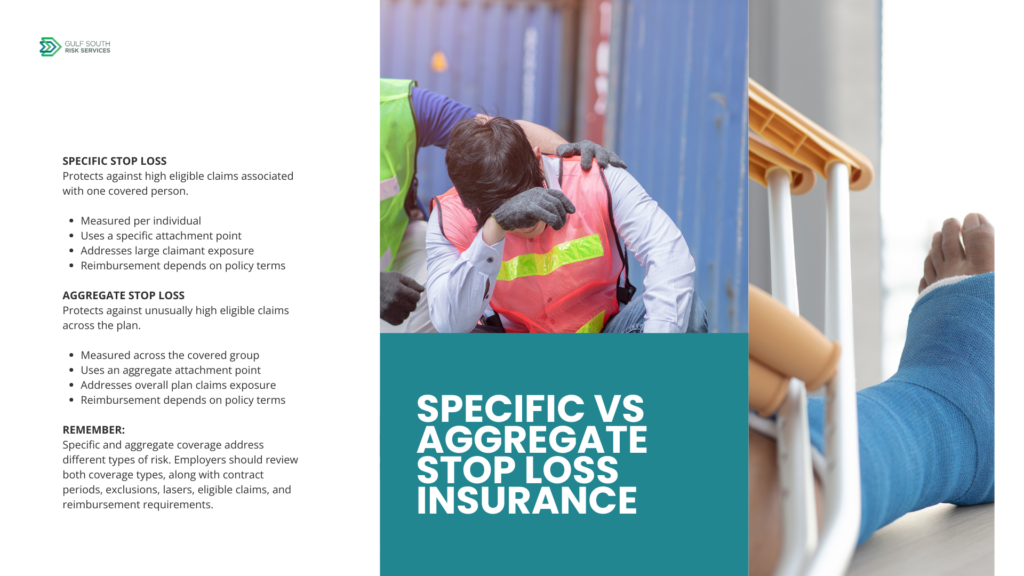
Aggregate coverage generally addresses overall plan exposure, while specific stop loss insurance addresses high claims for an individual.
Specific vs Aggregate Stop Loss Insurance
Specific and aggregate stop loss insurance address different types of employer claims risk. Many self funded employers evaluate both rather than treating the two forms of protection as interchangeable.
| Factor | Specific Stop Loss | Aggregate Stop Loss |
| Main purpose | High claims for one covered person | High total claims across the plan |
| Trigger | Individual claims exceed the specific attachment point | Total eligible claims exceed the aggregate attachment point |
| Measurement | Per covered person | Across the covered group |
| Common concern | One severe or prolonged claim | Overall claims running above projections |
| Reimbursement | Subject to specific policy terms | Subject to aggregate policy terms |
What Is an Attachment Point?
An attachment point is the threshold that must be reached before eligible claims may qualify for stop loss reimbursement. Specific policies use an individual threshold, while aggregate policies use a plan-level threshold.
A lower attachment point may reduce the amount of retained exposure but can affect the policy premium. A higher attachment point means the employer retains more claims risk before potential reimbursement begins.
Employers should evaluate attachment points in relation to cash flow, enrollment, claims history, risk tolerance, and policy cost rather than selecting a threshold based on price alone.
What Stop Loss Contract Terms Matter Most?
Stop loss contract terms determine how protection actually operates. Employers and brokers should review the following:
- Contract period: Defines the policy period and the claims timing rules that apply.
- Incurred date: The date the covered service or expense occurred.
- Paid date: The date the health plan actually paid the claim.
- Run in coverage: May cover certain claims incurred before the new policy period but paid during it, subject to the contract.
- Run out or terminal liability coverage: May address certain claims incurred during the policy period but paid afterward, subject to contract terms.
- Eligible expenses: Not every payment made by the health plan is necessarily eligible for reimbursement.
- Exclusions and limitations: Certain treatments, expenses, plan provisions, or claim circumstances may be excluded or limited.
The treatment of incurred and paid claims, reimbursement timing, and terminal liability coverage varies by policy. Contract language controls.
What Is Lasering in Stop Loss Insurance?
Lasering is a stop loss underwriting provision in which a higher specific attachment point or special limitation is applied to a known high risk individual or claimant.
A laser may be proposed during underwriting or renewal. This can mean the employer retains more risk for that individual than for other covered members.
Employers should examine the proposed threshold, duration, disclosure requirements, and alternative terms. A laser can materially affect the employer’s potential exposure, so it should be evaluated alongside the broader stop funding risk management strategy.
What Does Stop Loss Insurance Not Cover?
Stop loss insurance does not necessarily cover every amount paid by a self funded health plan. Depending on the policy, potential limitations may include:
- Claims that are not covered under the health plan
- Expenses excluded by the stop loss policy
- Claims outside the applicable contract period
- Late or incomplete reimbursement submissions
- Amounts above applicable policy maximums
- Administrative fees
- Certain plan expenses that do not meet the definition of eligible claims
- Claims affected by disclosure or underwriting provisions
Stop loss insurance should not be treated as a guarantee that every amount above an attachment point will be reimbursed. The policy determines which claims qualify and how reimbursement is calculated.
What Should Employers Review Before Selecting Stop Loss Coverage?
Employers and brokers should review the full policy rather than comparing premiums alone. A practical checklist includes:
- Specific attachment point
- Aggregate attachment point
- Contract period
- Eligible claim definition
- Medical and pharmacy claim treatment
- Lasers
- Policy limits
- Exclusions
- Disclosure requirements
- Reimbursement procedures
- Advance funding or accommodation provisions, when available
- Renewal terms
- Carrier financial and service considerations
- Coordination among the employer, TPA, broker, and carrier
A lower premium may come with a higher retained risk, different contract terms, or other reimbursement conditions.
Gulf South Risk Services can help employers and brokers review how stop loss terms interact with claims administration, reporting, and the broader self funded plan structure.
How Does Stop Loss Insurance Protect a Self Funded Employer?
Stop loss insurance may place a defined boundary around certain high claim exposures. Specific coverage may reduce the financial effect of one unusually large claimant, while aggregate coverage may provide protection when total eligible claims exceed a plan-level threshold.
This structure can support budgeting and self funding risk management by establishing defined points at which the stop loss carrier may reimburse the employer.
However, the degree of protection depends on attachment points, exclusions, the contract period, claim eligibility, reimbursement procedures, and other policy provisions. Stop loss insurance does not eliminate employer claims responsibility or all financial risk.
Questions to Ask About Stop Loss Insurance
Before selecting coverage, employers should ask:
- What is the specific attachment point?
- How is the aggregate attachment point calculated?
- Which claims are considered eligible?
- When must claims be incurred and paid?
- Are any individuals subject to lasers?
- How long does reimbursement review typically take?
- What exclusions, limits, or disclosure requirements apply?
Employers should request clear written answers and compare those answers with the plan document, administrative agreement, and stop loss policy.
For related guidance, employers can also review information about whether a self funded health plan is right for your organization, the role of a third party administrator, and employee health plan cost containment when evaluating the broader plan structure.
Discuss Stop Loss and Self Funded Plan Administration With Gulf South Risk Services
Stop loss coverage should be evaluated as part of the full self funded plan structure, not as a separate price comparison. Gulf South Risk Services can help employers and brokers understand claims administration, reporting responsibilities, vendor coordination, and the questions to raise when reviewing stop loss coverage. Contact Gulf South Risk Services to discuss your organization’s needs.